Wednesday, June 3, 2015

Can you do this job to the glory of God?

Last week, a helpful website The High Calling published a thoughtful article that I think might be of service to many who are in-between jobs or who have settled-in and gathered their breath sufficiently to re-evaluate what they are doing - and more importantly: For what purpose? 

CLICK HERE to read: Can you do this job for the glory of God?

God's larger perspective on work is that it is good (Genesis 2:1-3). Because He is good and He did work filling full the heavens and the earth, it is good. In fact, Genesis goes against Ancient Near Eastern and Greco-Roman labor principles which stated that working with one's hands in the dirt is among the most demeaning kinds of work. God Himself did just this in creating man! The Ancient Babylonian creation account asserts that the gods created man so that they didn't have to do any work. Our God finds great satisfaction in working on our behalf and to His glory!

May we find satisfaction in our work done on other's behalf and to His glory! 

Tuesday, May 26, 2015

Jesus speaks a better word - getting from the OT to Jesus (Sunday follow-up)

Wherever you open your Bible, you'll turn to some aspect of the life-transforming gospel of Jesus Christ. It won't necessarily be 4 points followed a closing prayer to trust your life to Jesus as Lord and Savior - but it might Moses' willingness to accept blame for sin he didn't commit (which in turn foreshadows us of Jesus' willingness to bear the blame for sin he didn't commit - Exodus 32:32; Isaiah 53:4, II Corinthians 5:21) or it might be an example of sin/idolatry for which Christ died (see also Exodus 32 - the golden calf).

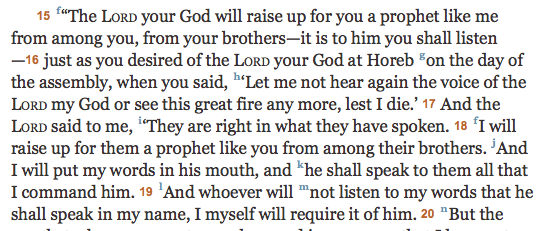
God's prophets were called to speak his word rightly. But each, including Moses, was sinful and none spoke His word fully. Jesus is God's perfect prophet - speaking the words of eternal life (John 6:68-69). Whenever we read the Old Testament prophets, we ought to ask: Where does Jesus speak a similar but better word? This might require a good study Bible or at least a Bible with marginal references (ie. little numbers or letters with Scripture references attached - usually pointing you to the New Testament). I want to introduce you to an excellent resource. Both the online and the print versions of the ESV Study Bible has an amazing section in the back entitled - The History of Salvation in the Old Testament: Preparing the Way for Christ. 

I have posted below from this section a selection screenshots of the OT prophets (including Isaiah, Jeremiah, Ezekiel, Hosea, Amos, Jonah, Zechariah). By looking through some of these and their corresponding references, you are training yourself for how to hear God's prophetic voice in the OT and connect it to an even better word spoken or fulfilled by Jesus.  


Monday, May 25, 2015

Moses Points to Jesus (Sunday follow-up)

Jesus & Moses -
Prophets who get between God and Man
Yesterday I had opportunity to present the ultimate life-purpose of one of the great men in Jewish and Christian history - the prophet Moses. This man's ultimate life-purpose was to point people up-the-road to a better prophet who would speak to us a better word - the prophet Jesus. 

I couldn't yesterday share all or even most of the Christ-pointing references to Moses - and only shared a couple of Jesus' own references to Moses. My aim here is to simply present the Scriptures that display Moses clearly pointing people to Jesus as a prophetic mediator - one who gets in-between to speak the people's words to God, and God's words to people. Jesus does this even better and forever. 

Moses as a prophetic type of Christ
Moses: An evil King tried to kill him as a baby (Exodus 1:22)
Jesus: An evil king tried to kill him as a baby (Matthew 2:16)

Moses: Sent into Egypt to preserve his life (Exodus 2:3-4)
Jesus: Sent into Egypt to preserve his life (Matthew 2:13-15)

Moses: Went from being a prince to a pauper (Exodus 2:18-19).
Jesus: Went from being heaven's prince to earth's servant  (John 1:1-3).

Moses: Shepherd (Exodus 3:1)
Jesus: Shepherd (John 10:11).

Moses: Bears the blame that the people deserved (Exodus 14:15; Exodus 32:32)
Jesus: Bears the blame that the people deserved (Isaiah 53:4)

Moses: "So the people feared YHWH, and they believed in YHWH and his servant Moses (Exodus 14:31).
Jesus: "Let not your hearts be troubled. Believe in God; believe also in me" (John 14:1).

Moses: Provided water for thirsty people (Exodus 15:22-25)
Jesus: Provided water for thirsty people (John 7:37-38)

Moses: Fed hungry people (Exodus 16)
Jesus: Fed hungry people in the wilderness (spiritual - John 6:31-35; physical Mark 8:1-9).

Moses: Fought a war with two outstretched arms and two men beside him (physical - Amalek - Exodus 17:8-16).
Jesus: Fought a war with two outstretched arms and two men beside him (spiritual - Satan - Colossians 2:14-15).

Moses: Finished the work God assigned him which led to God's presence (Exodus 40:33-34)
Jesus: Finished the work God assigned him which led to God's presence (John 19:30).

Moses on Jesus: 
Exodus 19:15-19


Jesus on Moses
At a count of 19x, Jesus refers to the person of Moses more than any other Old Testament character. Here are some significant ones:

  • In reference to people who preach Moses' law but don't practice what they preach (Matthew 23:2-3).
  • In reference to the resurrection of the dead being first spoken to and by Moses himself (Mark 12:26; Luke 20:37)
  • In reference to hearing Moses and the other prophets being enough to know how to gain eternal life and avoid hell (Luke 16:29-31).
  • "And beginning with Moses and all the Prophets, Jesus interpreted to them in all the Scriptures the things concerning himself" (Luke 24:27).
  • "As Moses lifted up the serpent in the wilderness, so must the Son of Man be lifted up" (John 3:14 - referring to the cross, looking to Christ crucified brings healing; cf. Numbers 21:9)
  • "Do not think I will accuse you to the Father. There is one who accuses you: Moses, on whom you set your home" (John 5:45 - everyone at some points places their hope on their performance with respect to some form of the Law which is based on the Law of Moses - since we are unable to live up to it, it "accuses" all who hope in it for the day of judgment).
  • "For if you believed Moses; you would believe me; for he wrote of me" (John 5:46 - cf. Deuteronomy 19:15-19).
  • With reference to food that will truly sustain you forever (John 6:32).

Be encouraged that you have a sure anchor that forever assures you who trust Jesus. God has had this plan all along to reconcile human beings to Himself. John 1:17 - "The Law came through Moses... (a mediator subject to death who gave people an temporary way to please the God who had delivered them from bondage) ...grace and truth came through Jesus Christ" (a mediator living forever who gave people a permanent way to please the God who delivers them from bondage). 

Wednesday, May 13, 2015

I deserve anything...

When I ponder the grace of God, I often do so in terms of: "I deserve nothing...yet I've
been given every good gift" (cf. Romans 8:32). This is the passive reception of grace. There is another side of grace, which Tim Keller calls, the threat of grace. It says: "I deserve anything that is asked of me." This is the active response of grace. While re-reading Keller's The Reason for God I was reminded of this side of grace:
Some years ago I met with a woman who began coming to church at Redeemer. She said that she had gone to church growing up and had never before heard a distinction between the gospel and religion. She had always heard that God accepts us only if we are good enough. She said that the new message was scary. I asked her why it was scary, and she replied: "If I was saved by my good works then there would be a limit to what God could ask of me or put me through. I would be a like a taxpayer with 'rights' -- I would have done my duty and now I would deserve a certain quality of life. But if I am a sinner saved by sheer grace - then there is nothing he cannot ask of me."
Here's a woman whose first response to the gospel of grace isn't sheer awe or wonder (as is/was the case for many of us) but: "I'll take any assignment!" I immediately think of Mary accepting her assignment of carrying then raising the Messiah under scandalous glances and rumors (Luke 1:38) or God's arduous assignment to Paul (then Saul) after rescuing him from his bondage to hate (Acts 9:16). 

Yet it is really no threat at all as we are increasingly gripped by what grace has done - you've been chosen! Not because of how good you are on the inside or out, but simply because you are undeservedly loved. A Bridegroom has chosen to wed you (Rev. 19:7) whilst a Father has chosen to adopt you (Ephesians 1:5). A friend of mine, who was adopted around the age of 10, can recall after putting a few of his things into his new home happily declaring: "I'm ready for my first assignment."

Are you ready to receive any assignment He might give you? Your answer will almost certainly depend on whether your heart has yet been gripped by the grace of God.

Thursday, April 23, 2015

He Giveth More Grace

I love my local church. The family members for Sunrise Community Church are very dear to me as I hope those on your local branch of God's family tree are dear to you. Sunrise, I want to share something that moved me on your behalf this week.

Our local branch is spending Sundays in April considering the hope and wisdom God's Word offers for different seasons of life, each of which possessing inherent obstacles to our human limitations. For parents: Lack of sleep resources for those in the early years and lack of time resources as the kids get older (very soon for Katie and I: lack of money resources as they ask to go places with friends and off to university Lord willing). For spouses: The constant threat of war when two sinners get married and vulnerably open themselves up to another. Lack of unconditional acceptance you want him/her to change to be more like you (though you don't really want this) and lack of forgiveness because he/she should first say sorry...and maybe even grovel a little. For singles: Lack of clarity with regard to how one should utilize his/her time and lack of self-control to keep returning to God with occasional or regular loneliness  For those advancing in years: Lack of feeling valued by others and purposeful for God. 


Annie Johnson Flint
We have a resource to carry on and through these seasonal obstacles in the God-man Jesus Christ. When fighting to stay faithful for God and live different lives than the world, James reminds us: "But He gives more grace" (James 4:6a). Annie Johnson Flint (1866-1932) took hold of this promise and drank of it deeply throughout her life. Her mother died when she was just two and her father passed away three years later. She trusted her life to Jesus at age 8 and years later began teaching. She taught for 3 years until arthritis (as a teenager!) made it impossible to continue. Within two years, she was unable to walk. She had to give up her dream of being a concert pianist as her body was now twisted up in chronic pain. She spent her remaining years as an invalid, but through it all remained outward-focused, large-hearted in generosity toward others, writing poetry to the glory of God and benefit of others - often enclosed in letters to struggling sojourners like herself. Here is one of her poems that I hope reminds you of the manifold graces available to you through Jesus:


Grace is God's love made active through an undeserved gift. The ultimate grace we have is God himself - God, indeed, is the end goal of the gospel. So when a person trusts Jesus, they are forgiven by and reconciled to God the Father and receive God the Holy Spirit to live with and inside of them (Acts 2:38). The best and leased deserved gift - God Himself!! From Whom flows every other gift. 

My dear friend, in the midst of your seasonal trial: Boldly approach God and ask Him for more grace (Hebrews 4:15-16). Consider: Have you only assumed or actually asked? Grace may come in the form of a provision that reminds you of His presence, an answer to prayer that reminds you he hears not only the formal prayers but the terse and inarticulate grunts, a spiritual gift that sneaks up on you as you serve others (such that someone else has to point it out), a member of the body of Christ generously providing an encouraging word, an unexpected gift or a thoughtful offer of help, a sunset or ocean breeze gift-wrapped for you to enjoy (consider also the burrito and gelato!), a reminder of the cross to help you recall: "Yes, I forgive you again."  

Now that you've asked, take care to pay attention, because James also indicates that gifts are easy to miss because we just consider them normal or, worse, deserved. "Do not be deceived my dear brothers. Every good and perfect gift comes from above, coming down from the Father of lights, who does not change like the shifting shadows" (James 1:16-17). So pay attention to every good and perfect grace He is puts in your person or presence. And respond by fully pouring it out as an offering back to him through the thanksgiving of your lips and your service toward others - that He might giveth, and giveth, and giveth again.

Thursday, February 19, 2015

Should my giving be a secret?

John Richardson of GenerousChurch provides some helpful insight into the question: In light of Jesus' words in Matthew 6:2-4, should my giving stay behind shut doors?

We know from our Sunday study of II Corinthians 8-9 that generosity can't be as simple as all-secrecy at all-times. Paul found reason to unveil testimonies of generosity: "We want you to know brothers, about the grace of God that has been given among the churches of Macedonia, for in a severe test of affliction, their abundance of joy and extreme poverty have overflowed in a wealth of generosity on their part" (II Cor. 8:1-2). And: "I know your readiness [Corinthians], of which I boast about you to the people of Macedonia, saying that Achaia [the region in which Corinth resides] has been ready since last year. And your zeal has stirred them up" (II Cor. 9:2). Testimonies of generosity have tremendous potential to stir up others to respond with generosity of their own.

Click Here to read: "Should my Giving be a Secret?"

Wednesday, February 18, 2015

Giving up stuff I like makes me loathe Lent (*alternate purpose & plan included)

Giving up sweets, throwing away all chocolate, hiding the remote control, heading to bed earlier, putting away beer/wine, a fast from Facebook. This was the Lent of my childhood - except for Facebook (illegitimate for an 80s child) and beer (illegal for any child). Now fasting from these may prove a valuable discipline. I think it was Thomas Merton who once said: We should periodically abstain from any habit or indulgence to make sure we are not, in fact, enslaved to it. It's often when we intentionally remove an indulgence, habit, or possession that we realize it has owned us - not the other way around.  

True fasting is feasting. The 'part of us' we kind of miss lends us opportunity to further feast on Jesus for true life (John 6:57). Thus, the lenten season affords us a deliberate season of time to further experience the generosity of Jesus through taking that initial step of generously giving of yourself. The feast is the goal - not the fast!!

The idea behind Lent is to imitate Jesus who for 40 days fasted from food and abstained every other tempting indulgence offered him by Satan in the wilderness - money, political power, glory, pride (Luke 4:1-13). Why did he do this? To show that he could? No. To show us how we too can be rigorously self-disciplined? That's frightening. He stepped into concentrated evil - 40 years of temptation rolled into 40 days - so he could feast on his two rewards: Making Dad smile and being with the kids (see Isaiah 53:10). To elaborate: 1. Pleasing His Father (John 4:34) and 2. Being with you and me forever (by crediting his perfectly-lived life to our account - thus, he had to face just-like-us temptation without messianic short-cuts but could not falter). Jesus likewise fasted in order to feast.

An alternate and better purpose for Lent. Even as a liturgical past faded, I entered my adult years covertly loathing Lent and I've never really 'done' anything with that. I don't dislike it any longer but I lend to Lent little to no thought.  My heart & head are finally coming together to agree: Lent is not about giving up but getting willingly caught up in the adventure of divine generosity. Generosity is a response to a gift received (John 1:12) and a gift promised (Matthew 6:20). It's that first step that is so dang hard! A true sacrifice feels like a lonely step into oblivion. However, while it always feels like the sacrificial step of giving hurts to the point that it pinches (or even past the pinch!), the final word on the sacrifice is never pain, there is never an isolated gift, there is never an unnoticed deed, there is never an act of generosity that won't be rewarded with further generosity (2 Corinthians 9:11), even as we remember ultimate generosity (2 Corinthians 8:9).

An alternate and better plan for Lent. So I want to encourage you with a better plan for lent: Over the next 40 days resolve to get caught up in the adventure of feasting on divine generosity - and there is no other way than taking that first "pinching" step into what-seems-like-lonely-oblivion.

Here is the practical piece: Get a generosity challenge to your inbox every day until Easter. Sign up here. To the right you'll see a preview from the 40 Acts: Do Lent Generously Challenge. It also includes 3 different ways to complete each daily act (below). Take a moment to ask God if He would want you to join in. Other than receiving communications through obscure Briticisms (get ready for a "chin-wag" on Day 2), I have no idea what to expect but ... I'm up for a bit of adventure.


Wednesday, January 7, 2015

Jesus' journals - Finishing the Psalms so we can pray and sing them

"These commands I give to you today are to be upon your hearts" (Deut 6:4). 
"Hear, my son, your father's instructions" (Proverbs 1:8). 
"It seemed good...to write an orderly account for you, most excellent Theophilus" (Luke 1:3). 
"To all the saints in Christ Jesus who are at Philippi" (Philippians 1:1). 

Every book of the Bible is written to an audience like you or me - with the exception of the Psalms. I mentioned Sunday to all the saints in Christ Jesus at the the Harquail Theater, Seven Mile Beach: To have read your sister's diary when you were younger is to better understand the psalms. The psalms weren't addressed primarily to you or me - they were addressed to God. We look over-the-shoulder of an author as he pours out his heart (and ink) to God. It's like peeking into someone's private journals.

What we find when we peek into these journals is nothing short of tumultuous. Every conceivable emotion known to mankind seems find expression through these prayer-songs.  Sometimes these mood swings are from psalm-to-psalm, but often times they occur, inexplicably, mid-psalm. At one moment, the psalmist is basking in God's radiant love, the next: Exasperated from crying out in cold isolation. At one moment celebrating fellowship when brothers dwell in unity, in another asking God to contend with those who contend against me (even visiting violence on their family). 
Yesterday morning, our elders were reading through Psalm 139, where we found expression of God's nearness until, as one elder put it: "the bizarre bit in the middle" (which it seemed we might go ahead & skip over). 

These are cries of those wishing to trust a good God yet do so from a world that is falling apart around them. For psalmists living in B.C., it seems every victory is momentary and every promise of hope a bit hazy.

Momentary & Hazy - that is until one gets to know Jesus. Only in a relationship with Jesus (praying the psalms through Christ as it were) does the unresolved tension between trust in God and a world falling apart find certain victory and a concrete hope. Through Jesus, the psalms are opened wide! Apart from Jesus, the psalms are incomplete, an unfinished journal. When the famous novelist Charles Dickens died in June of 1870, he had been working his final literary work: The Mystery of Erwin Drood. The work was considered to be quite complex - beautiful in prose, a soaring treatment of mankind's complexities, authentic in displaying more of Dickens himself (a man otherwise unknown and rarely autobiographical). He had masterfully created a classic whodunit mystery...without an ending! Since then many have been inspired to take up the pen and finish the tale. It's been adapted into everything from a staple BBC period drama to a Broadway Play. To read the psalms apart from Jesus' finishing work is to agree, as with Dickens' unfinished work, the psalter is beautiful, soaring, authentic and yet cries out to be completed. 

Through his life, death, resurrection & reign, Jesus finalizes every hope in the psalms and finishes every victory. Thus, Jesus finishes these otherwise unfinished journals. Indeed, the psalms can be best understood, prayed and sung as Jesus' journals. Let's take a look as to how Jesus of Nazareth finishes and then restores to us these amazing prayer-songs.

Jesus finishes the psalms through His life.  In the gospel accounts, Jesus quotes from eight different psalms (Psalm 8:2; Ps. 118:22-23; Psalm 110:1; Ps. 118:26; Psalm 22:1; Ps. 82:6; Ps. 41:9; Ps. 35:19) . Based on this alone, one can imagine how often he used the psalms to pray when he was alone with his Father (Mark 1:35; Luke 5:16; Luke 6:12, Matthew 14:23). Why did Jesus so often pray and quote the psalms? Jesus, fully man, experienced and thus needed to express the full range of human emotions yet, fully God, never sinned in doing so. Consider how astounding that is compared to our expression of emotion, which is typically self-centered. When I weep: It is usually for my loss. Jesus wept for Lazarus, over the tragic effects of sin and death in this world, over Jerusalem. His sadness was utterly other-centered. When I get angry: It is usually because I am being deprived. When Jesus got angry (see temple courts), it is because everyday worshippers people were being subtly deceived by religious priests into temple-worship versus God-worship. So Jesus got angry on behalf of people deprived of genuine worship and on behalf of His Father being deprived of genuine worship. So when a Christian now prays-sings a psalm, he or she does so through a human who also experienced the very same emotion yet offers it to the Father free from the stain of self-centeredness because He prayed it purely while on earth. The Father thus hears our prayers through the sanctifying work of Christ and can both justly and generously respond. 


Jesus finishes the psalms through His death. In his suffering and death, Jesus endured every sinful emotion so the righteous anger expressed in the psalms wouldn't be expressed towards us. I admit that when I try to pray: "Oh God, slay the wicked" (Ps. 139:19) or "I loathe those who rise against you" (Ps. 139:21), I sometimes pray it sheepishly - wait a minute: "I art the man." Some Sundays I've preached on selflessness only to be short with my family the rest of that Sunday, telling myself: "You deserve to rest and be pampered." Wicked! "God, I think I'll do this project, meeting, relationship my way." Rising against You and Your ways! On the one hand, it is right to vent about the injustices we witness in this world trusting our Father to justly make right all the wrongs. On the other hand, I am one of the wrongs! So Jesus endured the mocking, the flogging, the anger, the humiliation, the grief in his suffering and death - saying "Father forgive them" - to demonstrate that he likewise endured both our sinful emotions and the righteous anger of the Father toward them. So recognizing am no longer the object of what would be just anger, I am liberated to authentically and without shame express frustration, impatience, even anger in the right way - to the Father, through the psalms, because of Jesus.

Jesus finishes the psalms through His resurrection. Take a moment to briefly read and maybe even say out (or whisper if in a public space) Psalm 43. 


After you pray the end (verse 5) and then rewind, you recognize the psalmist has previously experienced God as his hope and salvation. Now however history seems to be repeating itself. He's the victim of deceit and injustice (v.1). He feels rejected by God (v.2a). Takes about a 90-degree turn: Wait why am I so sad? Because of another human?! (v.2b). Please deliver me again (v.3). I know this will end with me filled with overflowing joy that results in praise to You (v.4). So in summary: Why am I so sad? (v.5a). God will again save (v.5b).

This resembles how many relate to God. Things are bad, woe is me, I better pray so God will make the bad things go away, I'm happy and back in church. Having hoped in God for a little while, rinse & repeat. 

When Jesus rose from the dead - he vindicated us with finality! Nothing can separate us from His love (Romans 8:38-39), whether it be the accusations of others, ourselves, or even the threat of death. He is not a temporary refuge from which we and our souls can escape but through simple faith our lives are "hidden with Christ" on high (Colossians 3:3). No matter what we do or anyone else does, He will surely bring us to His Holy hill and to His dwelling - "that where I am there you may also be" (John 14:3). Jesus pioneered the path to heaven through his resurrection that we might follow in his footsteps. So now when we pray the psalms: All the wondering, questions and shifts in mood caused by a hazy hope and changes in circumstances (does this mean God is no longer for me?) are answered with finality through the resurrection of Jesus. The penalty of sin is paid, the power of sin is daily lessening, the presence of sin will one day be eradicated - because Jesus has risen finalizing all the deliverances & joys of the psalms. The risen Jesus is the AMEN at the end of every psalm!

Jesus finishes the psalms through His reign. Many of the psalms celebrate God as king, yet it seems difficult to recognize his kingdom on earth "as it is in heaven." Psalm 24 captures this tension well: "The earth is the LORD's and the fullness thereof" (v.1). It's his world and yet: "Who shall ascend the hill of the LORD? And who shall stand in his holy place?" (v.2). The kingly line of God's people certainly did not demonstrate "the clean hands" or "pure heart" required but for anyone that did there remained: "blessing from the LORD and righteousness from the God of his salvation" (vv.4-5). This psalm concludes with a question repeated in such a way that the psalmist expects God to one day answer it:


Old Testament scholar Bruce Waltke notes that the songs in the book of Psalms that celebrate the king are like "royal robes." They are like the robes "with which Israel drapes each successive son of David at his coronation." But none of Israel's kings has shoulders broad enough to wear them. "The Psalter's giant robes hang loosely" until in the fullness of time - King Jesus comes. "Here was a son of David with shoulders broad enough to wear the Psalters magnificent robes."


These who first prayed the Psalms looked forward to the day when the King of glory might walk through the doors of this earth to reveal Himself. He has in Christ Jesus. So every time Christians pray about the majesty, royal rule, kingly authority, we can picture what true majesty, rule, authority looks like. And so as every psalm eventually meanders - twisting and turning - to its finish line, the finish line of the psalms is King Jesus. When we pray from the psalms to further witness and experience his majesty, rule, and authority, we can trust that we will - in-breaking spheres of His rule and reign through salvation, healing, and justice today even as one day we see all these things in full.

Oh may your kingdom come and will be done!

Friday, December 19, 2014

Why I've fallen back in love with y'all

When Katie, Mason & myself moved in 2005 from the frozen tundras of Chicago, Illinois to the pollenated southern United States (Tallahassee, Florida), I made a conscious decision that I would not give in to the use of y'all - be it in conversation or correspondence. I've always taken a little extra pride in employing correct grammar (it's the English Lit major in me - we have very little practical application of our studies!). I felt grammatically free of y'all after the now four of us moved to the multicultural Cayman Islands. I even secretly harbored a few  "told-ya-so" moments when listening to some Southern American friends struggle to try to explain y'all to persons of other cultures here in Grand Cayman. 

Falling back in love with y'all. Until, that is, in the Fall of 2010 when I re-discovered the brilliance of y'all. I was reading the book of Ephesians and I was astonished to re-read multiple prayers, teachings & exhortations as addressed to more than one person (as most of the New Testament is written to churches - 2nd person plural - not individuals). But it would be easy to read all of these brilliant verses as written to individuals because while the Original Greek has an expressed grammar that communicates "you" (plural), the English language does not. The British utilized "thou" as the second person singular for some time whilst reserving "you" for 2nd person plural. That faded by the end of the 17th century though. Back to Ephesians. Consider the difference y'all makes to how God's Word to us is understood & received:

1. Y'all were dead in your trespasses and sins (Ephesians 2:1)
Received individually (you): My story is that I was most definitely dead & following ways of the world, but some people's story may be different - some grew up Christian.
Received corporately as a church (y'all): There is not one person who wasn't dead and running in the other direction from God before He rescued them. Not one! We all collectively share some version of the same story.

2. But now in Christ Jesus y'all who were once far off have been brought near through the blood of Christ (Ephesians 2:13)
Received individually (you): I've been brought near for a personal relationship to God - Father, Son, Holy Spirit - because of what Jesus did. Every day is great if it's just you and Me, JC! 
Received corporately as a church (y'all): I've been brought near for a personal relationship to God - it's personal but not individual. I've also been brought near to others to experience with them eternal fellowship with God. 

3. [I pray] that y'all, being rooted and established in love, may have power together with all the saints, to grasp how wide and how long, how high and how deep is the love of Christ (Ephesians 3:17).
Received individually (you): Jesus, please fill my cup to know and experience your love as an overflow. Please also fill up Jimmy's cup that he might experience this too.
Received corporately as a church (y'all): Jesus, help us as a church body experience the overflow of your love. Jimmy & I will only experience loved pushed to its boundaries as a community - benefitting from one another's encouragements, gifts, wisdom, prayers as expressions of Your love.

4. Let know one deceive y'all with empty words, for because of these things the wrath of God comes upon the sons of disobedience (Ephesians 5:6).

Receieved individually (you): Jesus, please help me stay alert today for even the subtle lies of this world. Help me fight them off and remember they are empty promises.
Received corporately as a church (y'all): Jesus, help us as a church body fight off lies and empty promises. If one of my family members falls under deception, it could affect us all. Use me to encourage someone in the truth! Protect especially our Elders and leaders from the latest fads and false teachings.


Ephesians reminds us that Christ didn't so much die for individuals as he did for the church: "Christ loved the church and gave himself up for her" (Ephesians 5:25).
Curtain #1: Dividing mankind
from the Holy of Holies

How we went from you to y'all. By taking upon Himself the sin of the world as he died on the cross, Jesus was made unfit for His eternal community - Father, Son, Holy Spirit - "Eloi, Eloi, lema sabacthani" (Mark 15:34). His y'all was cruciformed into an alienated and isolated you. His eternal community - His forever church forsook Him. He did this to make you and I into a y'all. Remember the tearing of the temple curtain that occurred after he breathed his last (Mark 15:38)? Scholars have longed tried to figure out which curtain the gospel writers were referring to - because in the temple there were two curtains. Curtain #1: Divided the Holy of Holies from the Court of Men. This curtain kept sinners from perishing in the pure presence of a perfect God. Curtain #2: Divided the Court of Men from the Court of Women & the Court of Gentiles. It was a glorified airplane curtain dividing Coach from First Class (some of us just want to sneak a peek of what goes on in First Class). Curtain #2 symbolized that there are social divides that are not to be crossed. It is my opinion that the gospel writers are purposely vague on which curtain was torn - because they meant for their readers to consider both barriers obsolete. Through Christ's death, every dividing curtain is brought down (Ephesians 2:14). Thus, it's no longer you but y'all (you + Trinity) and it's not longer you but y'all (you + the church to which you belong).

Applying y'all to you. You are going to experience the goodness, the comfort and the encouragement of a communal God (Father, Son, HS) this Christmas Season. We can be confident of this because God works all things for the good of those who love Him (Romans 8:28). Such good is not simply meant for just you but for y'all! Who is your y'all with whom you will share blessing upon blessing? Who is your y'all with whom you will experience together the width, length, height, & depth of Christ's love?

This Advent Season, I've loved watching families of Sunrise light our church's Advent candles and lead us in a Reading. Doing it in the privacy of their home would suffice, but isn't it so much richer that they do this with community?! Equally, I can't wait to sing "Silent Night" on Christmas Eve. How much more full is the experience with a couple hundred family members letting their light shine forth! Maybe your y'all is comforting those in your church community who are lonely this Christmas or having a non-married member of your church to your home on Christmas morning for breakfast or to open stockings (what a blessing it would it be to even prepare for them their own stocking!).

Through Christ, we have a personal relationship with a Divine Community - Father, Son, Holy Spirit. It's meant to be personal, but it cannot stay individual. It's not meant to be. I'm just speaking the truth...y'all.

(If further interested: (1) Here's a ya'll version of the Bible!!; (2) Here's a respectable Brit who favors using y'all for the Bible; (3) Here's a longer article from a Southern-American theologian- contains extra nuggets of insight; (4) Here's an article on the Remarkable history of y'all) 

Tuesday, October 28, 2014

When you can't pinpoint the day/hour of your salvation: Baptism

For those of you who can't pinpoint the exact moment of your salvation, but wish you could: Consider the benefit of water baptism through your local church.  

Looking back during Days of Doubt. Just a few years after I first trusted Jesus who saved me from death to life (John 5:24), I began to wake up with doubts. I was in a university setting where students were openly invited to question the very existence of God, not to mention (a) One who is (b) masculine and (c) paternal and (d) would openly subject His Son to "divine child abuse" through the crucifixion. So there was an intellectual battle in which the "shrapnel" of ideas hostile to God filtered even into my very soul and paralyzed me from getting to my prayer closet and living by faith. I'd try and fight back with the Sword of the Spirit (God's Word - Ephesians 6:17), with all manners of prayers whilst asking others fight beside me in prayer (Ephesians 6:18). No doubt these weapons are effective and in no way ought to be muted by the one I'm about to highlight - the moment three years earlier when my eyes were opened to the truth that Jesus is Lord! The image of that day is burned into my memory: 
The table at which I sat and heard the message on 1 John 4:7-10. The outdoor bench at which I afterwards wept over the emptiness of my current life and the bitterness of my sinful heart toward God. Praying with a a Conan O'Brien look-alike named Chris, a summer camp staff member who had first approached me to tell me "dude, you're not where you're supposed to be right now" but changed course when he saw a young man whose life was being changed on-the-spot by the Savior.   
When I have exhausted all rational defenses for the faith and every spiritual weapon at my disposal to dispel doubt, I turn to those three connected images on that evening in the Summer of 1995 and am immediately filled with faith. You had only to know me prior - stubborn, self-indulgent, blind, miserable, lost. I had changed then and there. 

When racked by questions and doubt, I felt a lot like the man-born blind in John 9. After Jesus had healed the man, a mob brought him before the Jewish intellectuals who interrogated him with the aim of getting him to disown the work of Jesus (John 9:13-24). The now seeing man admits he doesn't know everything, but "One thing I do know: I once was blind but now I see" (John 9:25). I imagine, like me, the once-blind Bartimaeus looked back and drew upon the first image he saw after being both healed and saved by his long-awaited Savior (Mark 10:46-52) and that the apostle Paul vividly remembers the day the glorious light blazed as He heard His Savior speak to him (Acts 9:3-6), then immediately went blind (Acts 9:8-9). In fact, he was quick to share this moment with others and on various occasions (Philippians 3:4-11, Acts 22:1-22; Acts 26:1-23).

I can't relate to that radical salvation story. But not everyone who has trusted Jesus can relate. For so many of you, trusting Jesus was gradual. The images then of key moments are strung together over weeks, months, maybe even years. Although there was a moment "the transfer" from darkness to life definitively took place (Colossians 1:13-14), you can't pinpoint precisely when. So if/when you doubt that God really is there and should you wonder if you really have been saved, pointing back to the proof is a challenge. Firstly note, God thankfully entered our history and so gave us a historical moment in humanity's history through the actual life, death & resurrection of Jesus. His finished work is all we need to look to in giving us proof of His love (and the looking itself is evidence of His saving you). But being able to draw upon a concrete picture of His love breaking into your 21st century life, specifically, is remarkably helpful. "They have conquered Satan by the blood of the lamb and by the word of their testimony" (Revelation 12:11). 

Visual Reminders of His Salvation. I suppose the need to visually remember may be one reason why, prior to the advent of Jesus, God was so keen to have his people celebrate feasts and festivals. Seven in total, the feasts lasted up to 50 days, and represented ways for God's people to look back and remember His deliverance on their behalf. However, even deliverances such as the Day of Atonement (when God delivered the nation from sin) and the Passover (deliverance from slavery) were a process. The preparation of the high priest (Leviticus 16:3-5), the casting of lots (Lev. 16:3-5), the preparation of the scapegoat and sending him off into the wilderness (Lev. 16: 8-10), on and on until the high priest concludes the tenth day of the seventh month by going into the holy of holies and making sacrifice for sin (Lev. 16:33). So ends Yom Kippur, a.k.a. the Day of Atonement. Passover itself was a process - the plagues leading up to it, the lamb sacrificed, the blood of that lamb splattered on doors, angel of death, running, Egyptian chariots, parting of the Read Sea - you get the point! (for more see Exodus or The Ten Commandmentsignore the 4* rating on imdb, it deserves 5*!!). God's salvation was itself a process or series of steps. So to reignite so many images of genuine salvation, God commanded his people to remember them through celebrating feasts and festivals some of which reenact the salvation through songs, symbols, and the like. Turns out modern science confirms God's ancient practice re: the importance of human beings having mental photographs to draw upon for autobiographical purposes. As Christians no longer subject to the Old Covenant, we are not commanded to celebrate feasts and festivals because they all point to a final deliverance fulfilled in Jesus (Colossians 2:16-17). Through faith and His indwelling Spirit, we can feast on Jesus at any time and in any place (John 6:57). Jesus left behind two visual reminders of the deliverance He achieved for us - the Lord's Supper & Baptism. Both of which he commanded we celebrate.

What Baptism can do for you. Baptism cannot save you. I want to make this crystal clear. I do not wish to give off any hint that Baptism either saves or offers definitive assurance that you are saved. Only Jesus saves - this good news can become good for you by trusting that He is the God who can save and forever forgive your rebellion toward God. What baptism can offer you who cannot pinpoint your day of salvation: A visual reminder stamped into memory of what Jesus has done in and for you. Jesus caused you to be born again when you trusted him (John 3:3; 1 Peter 1:3); baptism is your birthday party. You get to choose your birthday theme - songs, Scripture readings, and your 'toast' to Jesus (expressing verbally to friends & family what He's done for you). Jesus reached into your history to kill and bury old identities and old trusts, forgive you, and has raise you to new life (see Ephesians 2:1-7); baptism is the Broadway Play of that history, based on a true story. Pictures will be taken of each of the three "Acts" of this stage play: You going down into the water (old life buried); a moment beneath the water (cleansing of forgiveness); and coming up from the water (resurrection). Here is your visual reminder of Jesus' work. The songs, the pictures, the church leaders responsible for overseeing your souls affirming your trust in Jesus (Hebrews 13:17), the church family who knows you well cheering and clapping because they've seen evidence of His work in your life. 

For those of you who cannot pinpoint the day/hour of your salvation but wish to look back and draw upon a definitive moment you celebrated its reality, consider contacting your pastor, elder, small group leader about Baptism. The picture is all there from one moment, on one afternoon - to be drawn upon duringsome later time of doubt. Those in the picture, a church family to later lean on to offer words of encouragement and assurance; church leaders entrusted to oversee your soul in the waters with you - affirming a genuine faith.