Wednesday, July 3, 2013

Keeping a Look-Out this Year

Hey, he was cool during the Age of Exploration!
Having finished up First John and packing my bags for a three week holiday in the States, I reflected on what God taught me most from that letter at the very back of the Bible - namely, that God is growing me less from understanding and analyzing myself and far more from looking outward to Jesus. For every look at my sin, five more times at my Savior; for every analytical moment, two more looks outward to His atonement; for every inward shame, a re-focus on Him who bore my blame. Okay...that counts as hopelessly cheesy use of rhyme but you are far more likely to remember cheesiness so ... WORTH IT! 

What stands out for me is the middle of 1st John, where 5x in 5 verses we can note visual verbosity: 

[28] And now, little children, abide in him, so that when he appears we may have confidence and not shrink from him in shame at his coming. [29] If you know that he is righteous, you may be sure that everyone who practices righteousness has been born of him.
[3:1] See what kind of love the Father has given to us, that we should be called children of God; and so we are. The reason why the world does not know us is that it did not know him. [2] Beloved, we are God's children now, and what we will be has not yet appeared; but we know that when he appears we shall be like him, because we shall see him as he is. [3] And everyone who thus hopes in him purifies himself as he is pure. (1 John 2:28-3:3 ESV)

None of this should be confused with
Double-A minor league baseball team:
The Chattanooga Look-Outs
On that note, I've been reading a morning and evening devotional from one of my heroes of the faith - Charles Spurgeon (19th c, Metropolitan Tabernacle Church in London, "Prince of Preachers"). I leave you with a devotion of his I read the other morning that puts what's rumbling round inside of me far better than I could. See you in August:


Looking to Jesus
Hebrews 12:2

It is always the Holy Spirit's work to turn our eyes away from self to Jesus. But Satan's work is just the opposite; he is constantly trying to make us look at ourselves instead of Christ. He insinuates, "Your sins are too great for pardon; you have no faith; you do not repent enough; you will never be able to continue to the end; you do not have the joy of His children; you have such a wavering hold on Jesus." All these thoughts are about self, and we will never find comfort and assurance by looking within. But the Holy Spirit turns our eyes entirely away from self: He tells us that we are nothing, but that Christ is everything. 

Remember, therefore, it is not your hold of Christ that saves you - it is Christ; it is not your joy in Christ that saves you - it is Christ; it is not even faith in Christ, although that is the instrument - it is Christ's blood and merits. Therefore, do not look so much to your hand with which you are grasping Christ as to Christ; do not look to your hope, but to Jesus, the source of your hope; do not look to your faith, but to Jesus, the founder and perfecter of your faith. We will never find happiness by looking at our prayers, our deeds, or our feelings; it is what Jesus is, not what we are, that gives rest to the soul.

If we are to overcome Satan and have peace with God, it must be by "looking to Jesus." Keep your eye simply on Him; let His death, His sufferings, His merits, His glories, His intercession be fresh upon your mind. When you waken in the morning look to Him; when you lie down at night look to Him. Do not let your hopes or fears come between you and Jesus; follow hard after Him, and He will never fail you.

My hope is built on nothing less
Than Jesus blood and righteousness:
I dare not trust the sweetest frame,
But wholly lean on Jesus' name.

Tuesday, June 25, 2013

The Curse of Passivity

Last night my boys and I were reading in bed about God's selection of David to succeed Saul as King of Israel. As the moral of the selection story is that God looks not at outward appearance but the content of one's heart  (1 Samuel 16:7), we prayed that God would give us a heart for God like David...when my oldest son Mason interrupted my prayer himself praying: "Except for his later heart when he has that guy killed in battle." We laughed and then prayed that. Mason was right though. While David was forgiven and restored by God, his heart was never quite the same after adultery with Bathsheba, killing her husband Uriah, and subsequently losing a child. He grew passive. He allowed his sons like Absalom to first drift, then rebel, and then only casually restore them when they repent (he tells Absalom, who kills his brother & David's son out of revenge: You can return to Jerusalem but don't drop by my [your father's] house...what?!!! - See 2 Samuel 15:24). In large part because he was neither confronted directly nor restored by his dad the king, Absalom returns to rebellion by trying to take his dad's throne. Passivity curses.

The curse of David's passive leadership. David teaches us so much with regard to a singular love and passion for God, patient trust in His promises, and even integrity. But at the very end of his life, we are taught through a negative example of his leadership passivity: In the midst of charging and blessing his son Solomon, he inadvertently curses him - by laying upon him a burden that should've been his own. Here's David to his son:
(1 Kings 2:5-9 ESV) 
[5] “Moreover, you also know what Joab the son of Zeruiah did to me, how he dealt with the two commanders of the armies of Israel, Abner the son of Ner, and Amasa the son of Jether, whom he killed, avenging in time of peace for blood that had been shed in war, and putting the blood of war on the belt around his waist and on the sandals on his feet. [6] Act therefore according to your wisdom, but do not let his gray head go down to Sheol in peace. [7] But deal loyally with the sons of Barzillai the Gileadite, and let them be among those who eat at your table, for with such loyalty they met me when I fled from Absalom your brother. [8] And there is also with you Shimei the son of Gera, the Benjaminite from Bahurim, who cursed me with a grievous curse on the day when I went to Mahanaim. But when he came down to meet me at the Jordan, I swore to him by the LORD, saying, ‘I will not put you to death with the sword.’ [9] Now therefore do not hold him guiltless, for you are a wise man. You will know what you ought to do to him, and you shall bring his gray head down with blood to Sheol.”
Shimei had cursed David in one David's lowest moments - temporarily leaving his throne and on his way out of Jerusalem riding a donkey (1 Samuel 16:9-14). David essentially forgave Shimei and made to him what was perhaps a rash promise - but, even if not, one that should have extended beyond his life. Clearly David had forgiven but not forgotten - evidence that he had not, in fact, forgiven. More egregious was his command (or, worse, strong insinuation) to Solomon to not let Joab's "gray head go down Sheol in peace" (v.6). Joab was a largely faithful and certainly longstanding commander of David's military. But David constantly let Joab off the hook for egregious acts of aggression, most of which violated the king's direct order. BUT Joab was good at what he did - so David largely let it go - at least until this day when he would saddle Israel's next leader with the role of "bad cop." 

The reality of your leadership & temptation to passive. Everybody leads somebody or, at least, should be. Such leadership might be in a church, a workplace, a family, or in your community. Somebody looks up to you and responds to your example (sometimes by avoiding doing what you do or imitating what yo do). It is becoming increasingly tempting in our day and age to lead passively - to be the laid-back leader, the no worries pace-setter, the fun friend who happens to also be your parent, boss, project manager, pastor, teacher. But what happens when you're gone - either temporarily or permanently? Can the person you've lead replace you? Have you been sufficiently intentional with them now to set them up for success later? Is the legacy you leave going to be a clean slate with only the treasures of your good counsel, patient 'training' and humble example framing an otherwise fresh start? 

Objection: What about Let Go & Let God? I just met with a dear friend who lamented that they too often try to intervene and control a situation rather than allow God to work. That is a legitimate problem in any form of leadership - you want them to 'get it,' you want them to grow, or, a bit less healthily/OCD, you want them to perform a function in a certain way. Patience is required. But there is an alternative to the two extremes of either Let Go/Let God or GoGoGo/Get'erDone. Namely: Trust God AND Dig In. Let God and Let God implies that we are to no longer concern ourselves with something important until God acts. But that is now how the Bible conceives of trust. Biblical trust is (a) going to God with the concern and constantly entrusting Him with it in prayer. Hence the parable of the persistent widow (Luke 18:1-8). Prayer is envisioned as God doing the change while we struggle (Colossians 4:12). More important to God than security or military guards to watch over His people was armies of hard laborers in prayer (check out Isaiah 62:6-7). Biblical trust is (b) patiently keep doing what you are doing as you trust God is at work both in you and behind-the-scenes. Hence: Paul keeps working to see people grow in Christ though understanding the ability to work is only because God is at work (Colossians 1:28-29); the believer keeps working at growing but God does all the heavy lifting (Philippians 2:12-13); there is a rest you can only find in continuing to work (Matthew 11:28-30) - but the difference, as highlighted by Jesus in these last verses, is you have someone sharing the yoke and doing the work with you. Your co-worker happens to be the resurrected God of the universe, Jesus Christ. Similarly, when you struggle and labor in prayer, the idea is that you get God, who becomes a Refuge and a Rest in a way that simply "letting go" or getting it out of your mind never can or will be.


Signs you might be drifting toward passivity & what you can do about it. 
1. You have not given away a vision. David possessed a singular mission & vision for his life, which I think is best expressed in Psalm 27:4: "One thing I ask of the LORD / this is what I seek / to dwell in the house of the Lord all the days of my life / to gaze upon the beauty of the Lord / and to seek Him in his temple." While David demonstrates such a singular passion and trust to those who fought with and for him (see 2 Samuel 23:16-17; 1 Samuel 24:3-7), such instruction and example is wholly absent in interacting with those over whom he had the most influence - his children. We have a family mission: "To make disciples who grow by grace in becoming mature in Christ." Accordingly, Katie and I take any opportunity to show our kids every gift of grace comes from above (James 1:16-17), we are totally dependent on God working to save us and others (Romans 9:16), it is returning to the cross daily that strengthens us (Hebrews 12:2-3) and helps us become more loving (Luke 7:47). Frankly, this happens a lot by responding well to sin - which we do a lot! (I am a professional sinner and amateur pastor). Katie and I demonstrating forgiveness of one another in front of our children, asking our children for forgiveness when we are unnecessarily harsh toward them or, in other cases, not harsh enough (let disobedience go unpunished out of our own laziness), giving God credit as much as possible, helping them see the importance of hard work and discipline as a response to God's grace not in order to earn it, giving to others as a family in recognition of His gift toward us are ways we intentionally impressing a godly vision upon our 'replacements.' What about you? What's your mission and vision? How are you passing this on?  As a recent guest preacher reminded our people: When the Bible talks about "drifting," it is always toward disobedience and never toward God. Intentionally give away a God-sized vision.

2. When those closest come calling, you sigh, gripe and roll. When those closest to us (you know the kind who are so close and familiar that your rep won't be ruined if you don't respond angelically) come asking for something, seeking help or guidance, reach out for a listening ear, you find yourself rolling your eyes a bit more at the Caller ID, sighing at their voice from far away, or respond a bit abruptly to their needs - this is a sign that you've stopped caring to lead them well. It's so strange: But haven't you found that those with whom you're closest often get your 'scraps' at the end of the day or in a less pressurized moments? This defies logic, especially considering it is these upon whom you will have the greatest long-term influence (probably not that client, nor fitness instructor, nor little Jimmy's teacher). As highlighted above, David was ready for work-life and gave his best to it. He was likewise ready for church-life - he even wrote a good portion of the Bible's songbook. But was he too preoccupied on his walk home with success in these areas to consider: How is Joab really doing in loving God? If I've really forgiven others, why the bitterness inside? Am I really ready to minister to my family? If you are like me and at some point during the day travel back to those with whom you are closest (home, restaurant, gym, etc.): Use that time in the car or on your bicycle to ask God to refresh you, forgive you, renew you, get your mind and heart right so you can minister and lead well. When you arrive, God will have you ready to listen to problems, ask good questions, draw out desires & goals, and help them both plan and work toward greatness.

3. People soon suffer in your absence. You see the writing on the wall. "The quality of work will suffer a bit and these people will miss me when I'm gone." And too often we secretly envision this as a sign of our worth and contribution - but really it's the failure of passive leadership. David thinks he sets up Solomon for success by getting all the materials together to build a temple to God (1 Chronicles 29:1-2). But he saddles Solomon with the immediate problems of a renegade military commander whose personality is too large and decision-making unsound because both have gone unchecked and a father's last wish to exact justice where he failed to finalize forgiveness. In his classic work Spiritual Leadership, Oswald Sanders notes: "The true test of a person's leadership is the health of the organization when the organizer is gone." Would your absence leave: A vacuum in volunteering? Other potential servants paralyzed to step up? Family members ill-prepared to carry on with even a 'routine' emergency (ie. sickness, cancelled flight, last-minute project sprung upon you by your boss)? I know I need to be better trained in making at least 3-4 gluten-free meals for our kids which don't require a grill in Katie's absence while I need to show Katie how to access important financial documents and information in my absence. Perhaps a good starting point is: Should something happen to me, have I prepared someone to step in? If not, who should I ask? Approach them: "I may not always be around. Can I show you what I do?" Such an approach is an extension of the Apostle Paul's approach to training: "Follow me as I follow the example of Christ" (1 Corinthians 11:1).

An Example of the Blessing of Active Leadership. Most people have heard the story of Isaac Newton's discovery of the law of gravity after observing the fall of an apple. What few people know is that is that Edmund Halley, the astronomer who discovered Halley's Comet, provided for a young Newton the kind of active leadership that set him up for success and greatness. Halley didn't go the laid-back route of offering his pupil a couple encouraging words and lots of 'space' (so he could set about his own research on that comet). In fact, Halley challenged Newton to think through his original notions. He corrected Newton's mathematical errors and prepared geometrical figures to support his work. Not only did he encourage Newton to write his groundbreaking work: Mathematical Principles of Natural Philosophy, but Halley edited the work, supervised its publication, and financed its printing, even though Newton was wealthier and could much more easily afford the printing costs. Halley gave away vision, stuck with encouraging and patiently challenging Newton when Isaac wanted to give up (versus sigh, gripe, and roll), and left behind a far larger legacy in his absence - namely, Newton & his work on gravity - than in his presence. A truly great leader!

Wednesday, June 12, 2013

Praise God for cheerleading & truth-telling Spouses

Disclaimer: No idea who this is. But since my wife is neither old
nor a former cheerleader, I had to find an old-timey cheerleader.
As a man, I tend to bottle frustration, anxiety, doubt, and concern within and, if it wasn't for the elders in our church, the only person who would ever see those things exposed is my lovely wife, Katie. 

Over the past couple weeks Katie and I engaged in a weekend marriage seminar (ie. surgery) and celebrated our 12th anniversary. I am so grateful I get to spend my life with her. One of the reasons I am able to handle the adversity of disrespect, passive-aggressiveness, unexpected tasks from without is hearing her encouragement and cheerleading for Team Oelschlager (more ideas on cheerleading: Some great tips). And a reason I'm able to withstand and fight back against doubt, frustration, anxiety from within is her reminding me of what's really true.

I was reading this morning in Judges 13 about Manoah. Here's a guy whose wife is never mentioned by name even though she is first approached by an angel of God to deliver major news about a mighty son born to her and her husband who will defeat Israel's enemies, the Philistines (vv.3-5). When Manaoh prays for this angel to reappear, he again shows himself to his wife first (vv.9-10). Nevertheless, she remains conspicuously nameless. I like this because it more readily allows the reader, especially the male reader, consider his own spouse in her place.

Having encountered an angel, carried on a conversation with him, and mistaken him for God himself, Manoah begins to worry, doubt, even fear, which often occurs in a man's spirit once all the excitement dies down a little. But that is when his help-meet, his bride shines as she speaks truth into his life:
And Manoah said to his wife, "We shall surely die, for we have seen God." But his wife said to him, "If the LORD had meant to kill us, he would not have accepted a burnt and grain offering from our hands or shown us all these things, or announced to us such things as these"  (Judges 13: 22-23).
Praise be to God for cheerleading & truth-telling spouses, who like Manaoh's wife, remind us that God is good, has shown He has good plans for our lives, & has announced to us very good news (ie. the gospel) that can always and at any time bring us great hope.

Wednesday, May 29, 2013

Learning to Speak Cayman (The Letter B)

As mentioned in the first post (Learning to Speak Cayman - Letter A), my hope once a week or so is to share with you a little Caymanian vocabulary. Many of my readers are no doubt ex-pats who reside here in the Beloved Isle Cayman - and while each of us are required to speak English when you arrive on island, there is no such requirement to learn words & phrases unique to Cayman...now that the pressure's off, there is no better time like the present.

So here we go - straight outta the Cayman Islands Dictionary - some of my favorite Caymanian terms from the Letter B.

Bad Up (bahd-upp) Verb.  1. To vex or agitate the mind or emotions for the purposes of furthering progress or "getting the ball rolling." Used especially with customer service at restaurants or in long queues. Eg. "Anytime I orda from "Fake Cayman Restaurant mentioned as such because I don't want to offend anyone," I usually have to bad up because they take their time otherwise."
>> I appreciate this one especially because I can't find an suitable equivalent in the English vernacular. "Instigate" maybe, but that isn't necessarily confined to hurrying up customer service. Sometimes, you just gotsta "bad up" (or patiently love them like Jesus...wah-wah).

Banga Langa Langa (baing-ah laing-gah laing-gah). Interjection. 1. You're gonna get it; 2. You're in deep trouble; 3. Song of impending doom for a child. 
>> It just rolls of the tongue. Not only is it fun to say on the domestic side, I can see this one catching on in the workplace. As in: "What? You forgot to submit your TPS reports to Mr. Livingstone?!! It's banga langa langa for you."

Beast (bee'ce) Noun. 1. Obsolete or untrendy technology
>> Helpful for some of us here in Cayman who don't have the quickest access to the latest and greatest. For instance, I just upgraded to a digital watch with a calculator on it! Beast no longer, my friends!

Brand-new-Second-hand (brahn-n'yoo-seh-hun-hahn). Noun. 1. Previously owned by someone else but still in excellent, near-perfect condition. Eg. "My friend is selling the Blackberry his work just gave him because he wants an iPhone. It's brand-new-second-hand."
>> Two spectacular aspects about this gem (oversell?? Wait for it...). (a) Anyone who has ever been in sales, as I have been so blessed, recognizes the need to sell something that's basically new but you can't call it new. Options: "Floor model" (mmm...that means hundreds of hands have touched it); "Very good" (too sentimental - now I know it's not very new but because it served you so well that you now have an emotional attachment - making it more valuable in your mind than it really is); "Used only a handful of times" (oh yeah, whose hand?). You get the picture, the alternatives are scarce; (b) Brand-new-Second-hand provides the ideal alternative.

Broughtupsy (brot-up-seh). Adjective. 1. Having good manners as a result of a positive upbringing.  Eg. "I don't like watching that child, all his parents do is stick him in front of an iPad so he can't talk to adults. He has got no broughtupsy."
>> This term allows you to, in one word, simultaneously evaluate the child (because let's face it you need to) and build up/tear down the parents who have raised him. 
>> Plus, I like words that end in "sy" like "funsy" or "onesy."

Bunkey (bung-kih) Noun. 1. gluteus maximus
>> A Caymanian classic. Once had opportunity to even utilize this word, affectionately, in a sermon I gave.

Go forth in the confidence that you can drop one of these little beauties on someone today - impress a friend or a co-worker...or better yet, confuse a family member or spouse.

Wednesday, May 15, 2013

Something we can learn from the Christian TV station

There was something I had planned to bring up during Sunday's sermon and our examination of 1 John 2:12-14...but...ran...out...of...time. What I wanted to say was that this passage serves as a reminder that there is something beneficial we can learn from the bulk of the teaching found on Weststar's Channel 21 (a Christian TV network). Let's get God's Word out there before we go any further.  1 John 2:12-14: 


What is 2:12-14? This is an interesting set of verses, but what exactly is it? In all the commentaries, no one claims for it to be poetry for the sake of poetry nor a hymn, nor is it a blessing or benediction. As best as I can ascertain, it seems to be a poetic pronouncement of truth meant to provide assurance and comfort for the genuine Christian. Or, as is often said in the modern church: "Speaking truth into someone's life."  

Bold pronouncements & Weststar TV Channel 21. John provides some bold pronouncements here to some of which we might respond: "Yeah, sometimes but not always or even normally." For instance: You have overcome the evil one. To which you might say, "Sometimes I have these moments, but I also give in to temptation." The point John is making is that through the cross and the testimony that results (see Revelation 12:11), Satan has conclusively been defeated. Similarly: You are strong. To which you might protest: "Well, not really. I give in quite a bit to the lusts of the flesh or simply to those Reese's Peanut Butter Eggs over Easter." But John is saying, Jesus' has put His Word of salvation in you so you are strong even when you don't feel it and his strength working within you even more than "makes up for" any weakness on your end (see 2 Corinthians 12:9-10). The bulk of teaching on Weststar Channel 21 consists of what is known as "The Word of Faith Movement", or "Positive Confession," or, more crudely, "Name-it-and-Claim-it." One of the main tenets of this movement is that it blurs the lines of justification (our legal standing of being presently right before God) and sanctification (our becoming right with God as the Holy Spirit changes us to be more like Jesus). A great example of the distinction comes in Romans 6:11-14.
So you must also consider yourselves dead to sin and alive to God in Christ Jesus. Let not sin therefore reign in your mortal body, to make you obey its passions. Do not present you members to sin as instruments for unrighteousness, but present yourselves to God as those who have been brought form death to life, and your members to God as instruments for righteousness. For sin will have no dominion over you, since you are not under law but under grace.
The purple (v.11 and v.14) represents the reality of our justification and Paul uses what we call the indicative voice describing the way things currently stand (see also v.2, v.6, v.18., v.22). We are dead to sin. Sin will not have dominion over you. Hear the boldness, right? So why even talk about sin since you've overcome it?! Because Paul also includes verses 12-13 - the reality of the ongoing work of being saved and Paul uses the imperative voice to urge us to presently do in response to what has been done (see also v.19). Though Jesus has finished the work of paying the penalty of sin, we keep going to the cross to give us the strength, power & fuel to kill sin daily - not putting ourselves in situations to afford our bodies as instruments to be used by sin, putting Jesus on the throne of our hearts to reign where sin would wish to sit. So you will hear "The Word of Faith" teaching use terms like "victorious life" and we are like "little gods" because of extreme confidence in the work of justification to the extent that it has obliterated the ongoing work of sanctification. You might note already, however, the immediate appeal of seeing Scripture as a whole being a positive affirmation that the Christian can do anything.

First, the dangers of Word of Faith. I will limit myself here to two dangers with respect to blurring the lines of justification-sanctification and will largely try to stay out of the fray on issues of the Word of Faith movement as it relates to physical healing, prosperity and giving to "God's work" (for a fuller treatment on this movement see first Dr. Sam Storms' wonderful book review on the topic; secondarily, an even more sympathetic but helpful treatment from Jon Ruthven). 

The first danger of this teaching is the subtle shift of confidence from God to self even as we tag on "in Christ." The full weight of perspective and priorities shifts from who Christ is is to who I am in Christ. The latter is crucial - but often word of faith teachers encourage action more in the "who I am" (therefore I can assume God will give me the job, the role, the person, etc. for which I ask) than the "in Christ" aspect. It also ignores Jesus' teaching about the relatively small role we have to play in Him doing big things - God likes to use faith the size of a mustard seed to move a tree or even a mountain largely to remind persons that it's not the quality of their faith but the object of their faith who does the work (Luke 17:6; Matthew 17:20). I remember once hearing G.K. Chesterton saying wisely:
What we suffer from today is humility in the wrong place. Modesty has settled itself upon the organ of conviction; where it was never meant to be. A man was meant to be doubtful about himself but undoubting of the truth; this has been exactly reversed. Nowadays the part of man that a man does not assert is exactly the part he ought not to doubt - the Divine Reason...we are on a road to producing a race of man too mentally modest to believe in the multiplication table.
The magnetism of this teaching, in my opinion, also rests in the notion that the majority of the worlds problems are largely due to personal self-esteem issues. By subtly shifting the bulk of the focus to "who I am  in Christ," self-esteem is boosted - though even secular psychology has largely pushed back against the myth that low self-esteem is a problem.

The second danger of this teaching is related: Word of Faith Teaching tends to use Scripture in a man-centered, utilitarian fashion. Scripture becomes almost entirely a series of promises to claim and act upon. As the UK-based Alliance Commission on Unity and Truth among Evagelicals (whew...) pointed out about Word of Faith teaching:
[They employ] a highly utilitarian use of the biblical texts. Scripture is treated as a contractual or covenant document whose practical value lies almost entirely in the fact that it comprises a set of rules, laws, conditions, etc., which must be appropriated and activated by the believer in order to achieve spiritual and material success.
This is a problem. There are loads of questions we can ask of Scripture to help us, with the Holy Spirit's help, understand how God wants us to apply it. But as you can tell from a previous post, promises to be claimed consists of only one of about 10+ diagnostic questions. The brief prayer of a man named Jabez amongst a long list of the descendants of Judah is another example of this (1 Chronicles 4:8-11).

Second, what can learn from Word of Faith Teaching. Because we are sons and daughters of a King, dead to sin and alive in Christ, co-heirs with the Son, we have a status that allows us to "boldly approach the throne of grace" (Hebrews 4:16). The Word of faith movement rightly encourages a strong act of the will involved in faith. Trust in Jesus not only for salvation for present and ongoing activity in this world ought to translate into something beyond passive acceptance but an aggressive and zealous component of action ("stepping out in faith"), especially when God has clearly made or advocated a promise. I think therein lies the key. God does not promise each person wealth in this life, nor complete healing, nor a total freedom from the presence of sin.

1 John 2:12-14 is a great example of promises that can be claimed. If you trust Christ, you have overcome the ruling power of Satan, we do know Him who is from the beginning (Him whose track record is so good at providing all our needs that it pre-dates track records), your sins have been forgiven and Jesus is being glorified every day just based on this fact alone, that word planted inside of you is making you strong.

So as you walk out your door this morning, today, this evening, go with these truths as reality in your life (justification), then you will only be empowered to overcome harmful attitudes, misplaced priorities, false idols, to grow in a trusting relationship and knowledge of Him who is from the beginning, to further receive and experience the forgiveness of sins, and to daily feed yourself with God's Word to make you stronger (sanctification). That's how this Christian life works: Believing and acting like you are and so becoming who you are.

Friday, May 10, 2013

The Myth of Marriage Problems

Despite the title of this post, I really am writing to encourage you to sign-up for the Art of  Marriage Event on May 24-25 (this Sunday = last day to sign up). I do not at all mean to suggest that you are not experiencing problems in your marriage nor that you, as a result, do not need the tune-up or overhaul that I believe God can and will provide through the Art of Marriage (AOM). It's just that we unknowingly misplace the blame.

One of my favorite quotes on marriage comes from Dave Harvey, author of When Sinners say 'I Do'. He says:
How easy it its to use the phrase, 'We are having marriage problems,' as if the marriage created them.
Marriage still remains, in and of itself, an inanimate object incapable of producing anything - however, the two persons in a marriage are capable of producing problems. Hence the title of Harvey's book: When Sinners Say 'I Do.'  This means your worst fears, yes, will probably be realized. As someone who has signed up for the AOM Event said to me a few days ago: "Over the last month I haven't voiced frustrations to my spouse because I was waiting for the weekend to come so he can begin to identify his problems - then I realized, 'Yikes, maybe God wants to identify problems in me.'" 

Fear in marriage. ID-ing problems in you is almost certainly the case and might cause us to fear. This is similar to reading 1 John as we've started doing on Sunday Mornings - John forces you to re-examine if your faith is legit and to question if you really and truly know Christ. And, as I asked this past Sunday: What's the worse that can happen if you realize you are a massive problem to your marriage or wake-up to the reality that you really haven't trusted your life to Jesus?

Grace in marriage. See, the great thing about Jesus and encountering His plan for marriage is that He freely offers us this treasure that is totally foreign to what the world's solution and totally different from an improvement strategy that other religions would propose. That treasure is grace. Grace is God's love made active through an undeserved gift. That means at any moment -- even a moment of doubt, fear or even despair -- God can activate His love toward you even though you neither did anything to deserve it nor pushed a magic button to activate. All we have to do is really admit we need of His help and rescuing. 

God's grace can change a marriage. If you recognize that you need God's help to be the spouse He calls you to be (notice not: "If you recognize your marriage needs God's help") and, through the conference, identify specific idols, bad habits, and hurtful attitudes, I'm confident He will begin to activate His love toward you (ie. show you grace). I'll give you two ways the Bible talks about grace and which I'm specifically praying for every person attending - (1) He will help you and your spouse truly put the past behind you (forgetting) and (2) He will patiently teach you how to say "No" to all the potential idols, bad habits, and hurtful attitudes that used to beset you (buttons you used to push to get what you want or a desire to get in the first and last word on an issue). Here is what God's Word says about how His grace through Jesus helps with both (1) & (2). 
Not that I have already obtained this (being exactly like Jesus) or have already been made perfect, but I press on to take hold of that for which Christ Jesus took hold of me . Brothers, I do not consider myself yet to have taken hold of it. But one thing I do: Forgetting what is behind and straining for what is ahead, I press on toward the goal to win the prize for which God has called me heavenward in Christ Jesus     (Paul in Philippians 3:12-14).
People don't just forget the past and move on. The past creeps back in or comes back up. It always does - apart from real grace. Not just an admission of guilt with an admission of forgiveness, but real divine power within that forgiveness that heals. 
For the grace of God that brings salvation has appeared to all men. It [grace] teaches us to say "No" to ungodliness and worldly passions, and to live self-controlled, upright and godly lives in this present age   (Titus 2:11-12).
The grace of God is a patient but effective teacher to help you grow as a husband or wife. You can believe that God is going to change you and your spouse as you rely on His grace.

Take a chance on the AOM Event even though you will have to admit you need help - that's exactly the place where God can begin to activate His love in your life and that of your spouse.

Tuesday, May 7, 2013

Learning to Speak Cayman

Since moving to Cayman almost 3.5 years ago, I've assiduously read histories and asked old-timers countless questions about this great island. And because, especially early on (this has certainly changed some), SCC consisted almost entirely of ex-pats, I thought it would be a good idea to write about some interesting Cay-History stories, movements & characters (see Article #1, Article #2, Article #3, Article #4). The goal being to familiarize more people with the culture and nation where they make their home.  I received some positive feedback about folks enjoying those. So back by popular demand (and by popular demand I mean any amount more than three, one of whom can be my Mom), I bring you "Learning to Speak Cayman." 

While you may be required to learn to speak English to move here from off-island, Immigration does not require you to learn vocabulary unique to Cayman. So I thought I'd post some of my favorites courtesy of the Cayman Islands Dictionary. Let's learn together!

Air Condition (ere kun-dih-shun) Adjective. Any type of clothing that has holes in it, resembling A/C vents. 
>> Now this is perhaps my favorite of today's words in terms of making the most sense. In a hot climate, what's better than to be wearing something that allows a little breeze to blow through. It's air conditioning without CUC. 

All Now (awl now). 1. For all time, up until now. 2. To this day. Eg. "Pastor Ryan promised to use me in a sermon illustration, but all now he ain't done it."

Aweleh (awe-leh). Interjection from West Bay. 1. A startled reaction to a particular situation.  2. A verbal demonstration of surprise.  Eg. "Awleh! I didd'n know you could still run fast even though you are old enough to be my dad." 
>> As someone who loves the Bible, the Psalms, and worship music, any fun comment of surprise that includes the first part of Alle-lujah! can and should be used.

Ayegah (aay-gah). Adjective. 1. Feverish; 2. Cold chills. Eg. "I feel kinda ayegah, and the only prescription is more cow bell."
>> That's more about cow bell than anything.

Great stuff. And we didn't even get past the LETTER A. Okay, I encourage you join with me in my goal to choose & use ONE of these today in actual conversation. 

Monday, April 22, 2013

Update from the field: SCC in Honduras (Fri-Mon)

Unless the LORD builds the house,
those who build it labor in vain.
Unless the LORD watches over the city,
the watchman stays awake in vain.
It is in vain that you rise up early,
and go late to rest,
eating the bread of anxious toil;
for he gives to his beloved sleep  (Psalm 127:1-2)

I had opportunity to share these verses tonight with the "Sunrise 10" (and our many new friends) as we debriefed and testified to God's work today. We've only been here three days, each day rising up early and, for many, going late to rest...but not tonight, trust me. But one consistent thread of what folks shared tonight is how the Lord is doing the work of building -- in many cases literal (building the foundation of the orphanage's first building), in others symbolic (building into the lives of both children and adults in villages - through the love of Christ in both Word and deed), in all personal (He is doing a work to build us personally and us as a team representing SCC). And so tonight..."He gives to His beloved SLEEP"!! We are looking forward to this last one especially!

Day 1:  Football (soccer) with Kids, evangelism work, construction work on storage room for orphanage at the Village San Francisco.
Day 2: Sunday worship service, lunch with kids at the Buffalo village, door-to-door evangelism at nearby village, Evening worship service with congregation in Vale de Los Angelos (Valley of the Angels).
Day 3: Construction work on storage room for orphanage - pretty much all day long. Playing with kids and blessing them with Bibles and such.

What I'll do here is just include some pictures of our time so far and a comment or two along the way.


Team in waiting at Owen Roberts. Seating was unassigned but first come first serve so we are waiting here to make a mad dash for seats on that airplane.
Some of the goodies we gave to children without
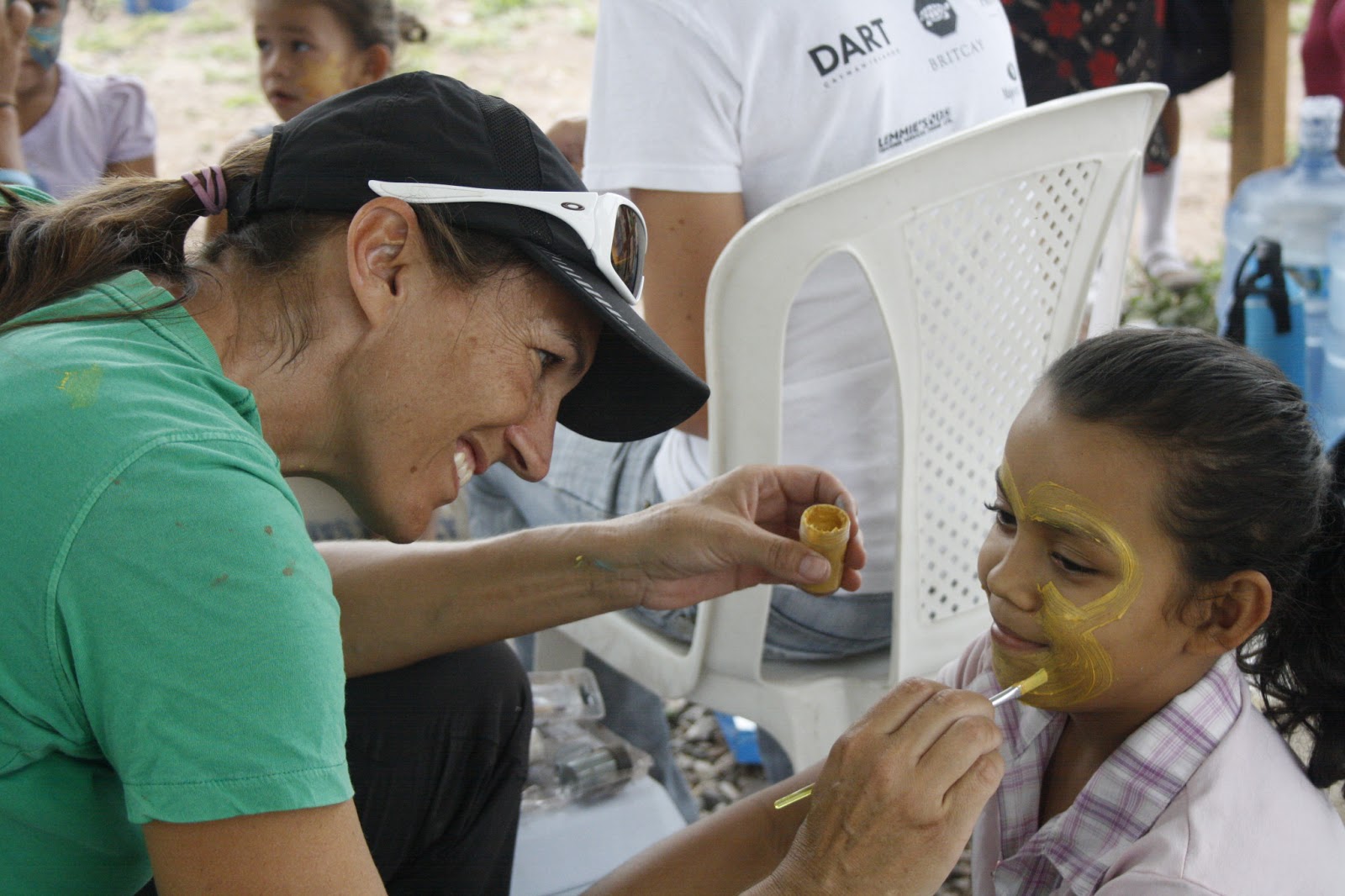
Tara Nielsen, Kimberly Parker & Genevieve Georgiades must've painted over 100 faces in just a couple days
The Work begins. Led by Mister Ray Jones of course. Omar Francis and our great missionary friend, Joe Denton.

I'm so proud of our team for taking advantage of both intentional and "surprise" opportunities to share the gospel. One afternoon we took bags of rice & beans and handed them out door-by-door along with a gospel presentation.
One boy, Orlando, found a bit of a crush on Genevieve Georgiades. I had to show him my wedding ring just so he'd stop forbidding me from talking with her.
Having allowed me to preach amongst his church body in Buffalo, Pastor Omar and I had a chance to visit his church facility whose roof was recently damaged. We raised enough money in offering to fix the roof!! Praise God!


Pinata Time. Things got nuts. Mad scramble for candy. One mother encouraged her daughter to go back into the mad scramble for more after she only retrieved a couple candies!


Helping Brother Ray complete the Sack Race - a great sport as always (and intense competitor)
Lovane (aka Coach Pelo) helping the kids succeed on the pitch

Sean Glidden entertaining us during some down time. He managed to survive.
Some of the completed work. Thanks to all who helped in the effort.

Puppet Show. Let's just say it wasn't a sell-out crowd for long...but we were grateful for "Di" "Si" & "Paul" to have made the journey from the Sunrise Children's Church all the way to Honduras.

Thank you all for your prayers. We really and truly sense their effectiveness! Please keep them up.


Monday, April 15, 2013

R.I.P. Brennan Manning (1934-2013)

I found out a couple nights ago that Brennan Manning died over the weekend. My response consisted of a few tears and a simple, "Thank you, Abba, for Brennan Manning."  
Manning was not the first to speak or write in great depth about knowing God as our "Abba" (an colloquial and familiar term for "father" in Aramaic, roughly translated to English as "PaPa" or "Daddy") nor was he the first to write about the wonder of God's grace or the relentless pursuit of God. However, he was my first teacher each of these concepts that have shaped my life even as they have since been distilled and refined through Holy Scripture, more steady theologians in history, and the invaluable gift of experiencing each of them through the Holy Spirit. 

Early on as new Christian, I searched for books to learn and know more in the first place I knew I could find them - the small bookshelf next to my parents' bed. It was there just a year before my university years that I stumbled upon The Ragamuffin Gospel by Brennan Manning. In his various literary works and through his speaking, Manning openly shares of his vast array of life experiences - his reluctance in entering priesthood to serving in the military, leaving the priesthood for the love of his life - Rosalyn, to the trauma of his alcohol addiction which later ruined his marriage to the same woman, spending six months in a cave in the Zaragoza desert to living among the poor with his Franciscan brothers. A summary of his zig-zag life can be found here on his official website.

As I reflected last night on his life, three impressions linger on my life:

1. You can learn and grow from someone you don't wish to imitate. The apostle Paul encourages the church of Corinth to "imitate me as I imitate Christ" (1 Cor. 11:1). There are and should be such actual persons that the Lord places in our lives whom we desire to largely (though not completely) imitate. Brennan Manning was not such a person. By all accounts his alcoholism - and specifically frequent omissions of its current toll on his life and lack of transparency toward those close with him regarding its pernicious stronghold on him - took his life. He drifted from the accountability structures and care he so needed from the local church - under the cloak of past hurts from Christendom's largest denomination. He brought significant hurt to his family. He often bordered on radical inclusivism that was far more broad than trust in Jesus alone for salvation and made many missteps when taking ethical stances on issues like homosexuality. BUT Manning was stubborn about grace (God's love made active through an undeserved gift) - both in his writings and his life. He fell a lot but kept getting back up off the mat. I learned that God not only loved me but liked me, that God had a deep and very personal love for sinners he liked to call ragamuffins (people who don't have it all together and are bumbling through life), I learned about a vast witness of various persons throughout history who had within them a testimony to the grace of God - Old English and modern fictional writers only found in history classes, obscure theologians and mystics from the middle ages, political leaders, modern teenagers who spoke better than they knew. A cast so wide-ranging and strange that I wondered if he made half of them up and then assigned to them wise quotes and awe-inspiring stories. 

This is a strange consolation to someone in my line of work. While I hope to someday be a person whose life is worth imitating, I don't think I'm there yet. However, I am confident my family, those closest to me, even the dear people of Sunrise whom I get to serve can even still learn and grow from me.

2. Manning was a flesh & blood reminder that the world is not my home. In 2000, I received the surprise gift of getting to go on a retreat weekend with Brennan Manning and a few other persons in Chapel Hill, North Carolina. It was a wonderful weekend! Each person had opportunity to sit down with Brennan for a kind of appointment. I made use of this opportunity as well as a late night in the den speaking with a few others present to pepper him with various questions about his writings, advice/counsel, more information on certain topics he discusses elsewhere only briefly. With each, Manning's answers were relatively pat and unusually resigned - all the while being as polite as possible. He had this look about him during that time (and others who have spent time with him on occasion confirm likewise) of wanting to be done with it. I am quite confident by this point he was wholly beset by his battle with alcoholism. Since then, every time I read these words I think of Manning:
For in this tent we groan, longing to put on our heavenly dwelling, if indeed by putting it on we may not be found naked. For while we are still in this tent, we groan, being burdened...we would rather be away from the body and at home with the Lord (II Corinthians 5: 2-4, 8)
Manning's closest spiritual kin was singer/songwriter Rich Mullins, who named his band The Ragamuffin Band after Manning's bestselling work. The two were very close. Manning, was so devastated by Mullins' young and untimely death that he couldn't bear up to show up and give the eulogy at his funeral. Rich Mullins was a bit of a human "misfit" -- socially awkward, ready even at the height of his fame to humbly ask to sleep on someone's sofa (he actually asked this of a friend of mine). He, thus, similarly at times seemed to be done with this life. 

I worry sometimes that this life and my lifestyle fits me too well, when my true home & citizenship lie elsewhere. These are two men remind me of a far greater future hope and reward that tends to motivate Christians less and less in an age whose average lifespan continues to trend upward. But more importantly it just makes Katie and I especially happy (and she said this to me last night) that Brennan in particular is with Jesus now. He looked forward to this day more than most.

3. The relentless pursuit of God through the grace of Jesus Christ. Manning wrote encouraged, exhorted and discipled me on this all-important, life-transforming, soul-satisfying subject during the formative years of my Christian life. 

My favorite Manning quote which I can still recite from memory: "The deeper we grow in the spirit of Jesus Christ the poorer we become - the more we recognize that everything in life is a gift and then the tenor of our lives becomes one of humble and joyful thanksgiving."

Thank you Brennan Manning for starting me down the road of recognizing both my true poverty and the great wealth I possess in Jesus Christ. And thank You, Abba, for Brennan Manning. 

Thursday, March 28, 2013

Hope: When do I keep fighting and when do I rest content?

Resurrection Sunday is drawing nigh. At SCC we'll be presenting the case for why the resurrection from the dead of a man named Jesus is the most defensible, possible and even plausible miracle in the Bible and worthy of one's belief. Please pray the Spirit begins working in the hearts and minds of those who attend (and whom you invite) even now to help them see for the first time to the truth and worth of this resurrected Savior. 

The resurrection from the dead is not only a Christian's but, deep down, any person's ultimate hope - that there is not only life beyond this life, but that life and even that physical body will be far more glorious than the present life and body which is subject to decay and whose end is death (Philippians 3:20-21). 

Equally, Jesus' resurrection from the dead gives us hope for the present life. It means Jesus is who he says He is - both God of the universe and our lives and the mediator between God the Father and mankind. 

So whenever I think of Easter I think of hope, which includes hope in God for the present to do big things in His church and through His will for me and my family. The apostle Paul expressed it this way in the midst of one of his most daunting trials: 

For we do not want you to be ignorant, brothers, of the affliction we experienced in Asia. For we were so utterly burdened beyond our strength that we despaired of life itself. Indeed, we felt that we had received the sentence of death. But that was to make us rely not on ourselves but on God who raises the dead. He has delivered us from such deadly peril, and he will deliver us. On him we have set our hope that he will deliver us again (II Corinthians 2:8-10)

Paul's internal calling & external circumstances provided a perfect place from which to ask one of the key real-life question pertaining to Hope: When do we keep hoping and fighting within a calling, for a dream, toward a goal and when do we rest content with circumstances look very much like God's settled will?

In his Nehemiah Notes, former pastor & experienced-bloke-who-has-walked-on-the-road-with-God Blaine Smith writes a very wise, insightful article on this question that's worth a read: CLICK HERE.

[Disclaimer: I do have a couple of small quibbles with the article. (1) Namely, I wish there was an explanatory section on the role of the Holy Spirit using His Word to shape, mold and form God-centered dreams and goals; (2) The frequent use of the word "potential." God absolutely has a full potential in mind for each of us in Jesus Christ and conforming us into His image (Rom 8:29). That word is so closely associated, however, with many self-help books and "Christian TV programs" which are actually quite man-centered. Overall, however, these quibbles don't outweigh the positives - the article is chalked full of wisdom and application from God's Word]