Wednesday, May 15, 2013

Something we can learn from the Christian TV station

There was something I had planned to bring up during Sunday's sermon and our examination of 1 John 2:12-14...but...ran...out...of...time. What I wanted to say was that this passage serves as a reminder that there is something beneficial we can learn from the bulk of the teaching found on Weststar's Channel 21 (a Christian TV network). Let's get God's Word out there before we go any further.  1 John 2:12-14: 


What is 2:12-14? This is an interesting set of verses, but what exactly is it? In all the commentaries, no one claims for it to be poetry for the sake of poetry nor a hymn, nor is it a blessing or benediction. As best as I can ascertain, it seems to be a poetic pronouncement of truth meant to provide assurance and comfort for the genuine Christian. Or, as is often said in the modern church: "Speaking truth into someone's life."  

Bold pronouncements & Weststar TV Channel 21. John provides some bold pronouncements here to some of which we might respond: "Yeah, sometimes but not always or even normally." For instance: You have overcome the evil one. To which you might say, "Sometimes I have these moments, but I also give in to temptation." The point John is making is that through the cross and the testimony that results (see Revelation 12:11), Satan has conclusively been defeated. Similarly: You are strong. To which you might protest: "Well, not really. I give in quite a bit to the lusts of the flesh or simply to those Reese's Peanut Butter Eggs over Easter." But John is saying, Jesus' has put His Word of salvation in you so you are strong even when you don't feel it and his strength working within you even more than "makes up for" any weakness on your end (see 2 Corinthians 12:9-10). The bulk of teaching on Weststar Channel 21 consists of what is known as "The Word of Faith Movement", or "Positive Confession," or, more crudely, "Name-it-and-Claim-it." One of the main tenets of this movement is that it blurs the lines of justification (our legal standing of being presently right before God) and sanctification (our becoming right with God as the Holy Spirit changes us to be more like Jesus). A great example of the distinction comes in Romans 6:11-14.
So you must also consider yourselves dead to sin and alive to God in Christ Jesus. Let not sin therefore reign in your mortal body, to make you obey its passions. Do not present you members to sin as instruments for unrighteousness, but present yourselves to God as those who have been brought form death to life, and your members to God as instruments for righteousness. For sin will have no dominion over you, since you are not under law but under grace.
The purple (v.11 and v.14) represents the reality of our justification and Paul uses what we call the indicative voice describing the way things currently stand (see also v.2, v.6, v.18., v.22). We are dead to sin. Sin will not have dominion over you. Hear the boldness, right? So why even talk about sin since you've overcome it?! Because Paul also includes verses 12-13 - the reality of the ongoing work of being saved and Paul uses the imperative voice to urge us to presently do in response to what has been done (see also v.19). Though Jesus has finished the work of paying the penalty of sin, we keep going to the cross to give us the strength, power & fuel to kill sin daily - not putting ourselves in situations to afford our bodies as instruments to be used by sin, putting Jesus on the throne of our hearts to reign where sin would wish to sit. So you will hear "The Word of Faith" teaching use terms like "victorious life" and we are like "little gods" because of extreme confidence in the work of justification to the extent that it has obliterated the ongoing work of sanctification. You might note already, however, the immediate appeal of seeing Scripture as a whole being a positive affirmation that the Christian can do anything.

First, the dangers of Word of Faith. I will limit myself here to two dangers with respect to blurring the lines of justification-sanctification and will largely try to stay out of the fray on issues of the Word of Faith movement as it relates to physical healing, prosperity and giving to "God's work" (for a fuller treatment on this movement see first Dr. Sam Storms' wonderful book review on the topic; secondarily, an even more sympathetic but helpful treatment from Jon Ruthven). 

The first danger of this teaching is the subtle shift of confidence from God to self even as we tag on "in Christ." The full weight of perspective and priorities shifts from who Christ is is to who I am in Christ. The latter is crucial - but often word of faith teachers encourage action more in the "who I am" (therefore I can assume God will give me the job, the role, the person, etc. for which I ask) than the "in Christ" aspect. It also ignores Jesus' teaching about the relatively small role we have to play in Him doing big things - God likes to use faith the size of a mustard seed to move a tree or even a mountain largely to remind persons that it's not the quality of their faith but the object of their faith who does the work (Luke 17:6; Matthew 17:20). I remember once hearing G.K. Chesterton saying wisely:
What we suffer from today is humility in the wrong place. Modesty has settled itself upon the organ of conviction; where it was never meant to be. A man was meant to be doubtful about himself but undoubting of the truth; this has been exactly reversed. Nowadays the part of man that a man does not assert is exactly the part he ought not to doubt - the Divine Reason...we are on a road to producing a race of man too mentally modest to believe in the multiplication table.
The magnetism of this teaching, in my opinion, also rests in the notion that the majority of the worlds problems are largely due to personal self-esteem issues. By subtly shifting the bulk of the focus to "who I am  in Christ," self-esteem is boosted - though even secular psychology has largely pushed back against the myth that low self-esteem is a problem.

The second danger of this teaching is related: Word of Faith Teaching tends to use Scripture in a man-centered, utilitarian fashion. Scripture becomes almost entirely a series of promises to claim and act upon. As the UK-based Alliance Commission on Unity and Truth among Evagelicals (whew...) pointed out about Word of Faith teaching:
[They employ] a highly utilitarian use of the biblical texts. Scripture is treated as a contractual or covenant document whose practical value lies almost entirely in the fact that it comprises a set of rules, laws, conditions, etc., which must be appropriated and activated by the believer in order to achieve spiritual and material success.
This is a problem. There are loads of questions we can ask of Scripture to help us, with the Holy Spirit's help, understand how God wants us to apply it. But as you can tell from a previous post, promises to be claimed consists of only one of about 10+ diagnostic questions. The brief prayer of a man named Jabez amongst a long list of the descendants of Judah is another example of this (1 Chronicles 4:8-11).

Second, what can learn from Word of Faith Teaching. Because we are sons and daughters of a King, dead to sin and alive in Christ, co-heirs with the Son, we have a status that allows us to "boldly approach the throne of grace" (Hebrews 4:16). The Word of faith movement rightly encourages a strong act of the will involved in faith. Trust in Jesus not only for salvation for present and ongoing activity in this world ought to translate into something beyond passive acceptance but an aggressive and zealous component of action ("stepping out in faith"), especially when God has clearly made or advocated a promise. I think therein lies the key. God does not promise each person wealth in this life, nor complete healing, nor a total freedom from the presence of sin.

1 John 2:12-14 is a great example of promises that can be claimed. If you trust Christ, you have overcome the ruling power of Satan, we do know Him who is from the beginning (Him whose track record is so good at providing all our needs that it pre-dates track records), your sins have been forgiven and Jesus is being glorified every day just based on this fact alone, that word planted inside of you is making you strong.

So as you walk out your door this morning, today, this evening, go with these truths as reality in your life (justification), then you will only be empowered to overcome harmful attitudes, misplaced priorities, false idols, to grow in a trusting relationship and knowledge of Him who is from the beginning, to further receive and experience the forgiveness of sins, and to daily feed yourself with God's Word to make you stronger (sanctification). That's how this Christian life works: Believing and acting like you are and so becoming who you are.

Friday, May 10, 2013

The Myth of Marriage Problems

Despite the title of this post, I really am writing to encourage you to sign-up for the Art of  Marriage Event on May 24-25 (this Sunday = last day to sign up). I do not at all mean to suggest that you are not experiencing problems in your marriage nor that you, as a result, do not need the tune-up or overhaul that I believe God can and will provide through the Art of Marriage (AOM). It's just that we unknowingly misplace the blame.

One of my favorite quotes on marriage comes from Dave Harvey, author of When Sinners say 'I Do'. He says:
How easy it its to use the phrase, 'We are having marriage problems,' as if the marriage created them.
Marriage still remains, in and of itself, an inanimate object incapable of producing anything - however, the two persons in a marriage are capable of producing problems. Hence the title of Harvey's book: When Sinners Say 'I Do.'  This means your worst fears, yes, will probably be realized. As someone who has signed up for the AOM Event said to me a few days ago: "Over the last month I haven't voiced frustrations to my spouse because I was waiting for the weekend to come so he can begin to identify his problems - then I realized, 'Yikes, maybe God wants to identify problems in me.'" 

Fear in marriage. ID-ing problems in you is almost certainly the case and might cause us to fear. This is similar to reading 1 John as we've started doing on Sunday Mornings - John forces you to re-examine if your faith is legit and to question if you really and truly know Christ. And, as I asked this past Sunday: What's the worse that can happen if you realize you are a massive problem to your marriage or wake-up to the reality that you really haven't trusted your life to Jesus?

Grace in marriage. See, the great thing about Jesus and encountering His plan for marriage is that He freely offers us this treasure that is totally foreign to what the world's solution and totally different from an improvement strategy that other religions would propose. That treasure is grace. Grace is God's love made active through an undeserved gift. That means at any moment -- even a moment of doubt, fear or even despair -- God can activate His love toward you even though you neither did anything to deserve it nor pushed a magic button to activate. All we have to do is really admit we need of His help and rescuing. 

God's grace can change a marriage. If you recognize that you need God's help to be the spouse He calls you to be (notice not: "If you recognize your marriage needs God's help") and, through the conference, identify specific idols, bad habits, and hurtful attitudes, I'm confident He will begin to activate His love toward you (ie. show you grace). I'll give you two ways the Bible talks about grace and which I'm specifically praying for every person attending - (1) He will help you and your spouse truly put the past behind you (forgetting) and (2) He will patiently teach you how to say "No" to all the potential idols, bad habits, and hurtful attitudes that used to beset you (buttons you used to push to get what you want or a desire to get in the first and last word on an issue). Here is what God's Word says about how His grace through Jesus helps with both (1) & (2). 
Not that I have already obtained this (being exactly like Jesus) or have already been made perfect, but I press on to take hold of that for which Christ Jesus took hold of me . Brothers, I do not consider myself yet to have taken hold of it. But one thing I do: Forgetting what is behind and straining for what is ahead, I press on toward the goal to win the prize for which God has called me heavenward in Christ Jesus     (Paul in Philippians 3:12-14).
People don't just forget the past and move on. The past creeps back in or comes back up. It always does - apart from real grace. Not just an admission of guilt with an admission of forgiveness, but real divine power within that forgiveness that heals. 
For the grace of God that brings salvation has appeared to all men. It [grace] teaches us to say "No" to ungodliness and worldly passions, and to live self-controlled, upright and godly lives in this present age   (Titus 2:11-12).
The grace of God is a patient but effective teacher to help you grow as a husband or wife. You can believe that God is going to change you and your spouse as you rely on His grace.

Take a chance on the AOM Event even though you will have to admit you need help - that's exactly the place where God can begin to activate His love in your life and that of your spouse.

Tuesday, May 7, 2013

Learning to Speak Cayman

Since moving to Cayman almost 3.5 years ago, I've assiduously read histories and asked old-timers countless questions about this great island. And because, especially early on (this has certainly changed some), SCC consisted almost entirely of ex-pats, I thought it would be a good idea to write about some interesting Cay-History stories, movements & characters (see Article #1, Article #2, Article #3, Article #4). The goal being to familiarize more people with the culture and nation where they make their home.  I received some positive feedback about folks enjoying those. So back by popular demand (and by popular demand I mean any amount more than three, one of whom can be my Mom), I bring you "Learning to Speak Cayman." 

While you may be required to learn to speak English to move here from off-island, Immigration does not require you to learn vocabulary unique to Cayman. So I thought I'd post some of my favorites courtesy of the Cayman Islands Dictionary. Let's learn together!

Air Condition (ere kun-dih-shun) Adjective. Any type of clothing that has holes in it, resembling A/C vents. 
>> Now this is perhaps my favorite of today's words in terms of making the most sense. In a hot climate, what's better than to be wearing something that allows a little breeze to blow through. It's air conditioning without CUC. 

All Now (awl now). 1. For all time, up until now. 2. To this day. Eg. "Pastor Ryan promised to use me in a sermon illustration, but all now he ain't done it."

Aweleh (awe-leh). Interjection from West Bay. 1. A startled reaction to a particular situation.  2. A verbal demonstration of surprise.  Eg. "Awleh! I didd'n know you could still run fast even though you are old enough to be my dad." 
>> As someone who loves the Bible, the Psalms, and worship music, any fun comment of surprise that includes the first part of Alle-lujah! can and should be used.

Ayegah (aay-gah). Adjective. 1. Feverish; 2. Cold chills. Eg. "I feel kinda ayegah, and the only prescription is more cow bell."
>> That's more about cow bell than anything.

Great stuff. And we didn't even get past the LETTER A. Okay, I encourage you join with me in my goal to choose & use ONE of these today in actual conversation. 

Monday, April 22, 2013

Update from the field: SCC in Honduras (Fri-Mon)

Unless the LORD builds the house,
those who build it labor in vain.
Unless the LORD watches over the city,
the watchman stays awake in vain.
It is in vain that you rise up early,
and go late to rest,
eating the bread of anxious toil;
for he gives to his beloved sleep  (Psalm 127:1-2)

I had opportunity to share these verses tonight with the "Sunrise 10" (and our many new friends) as we debriefed and testified to God's work today. We've only been here three days, each day rising up early and, for many, going late to rest...but not tonight, trust me. But one consistent thread of what folks shared tonight is how the Lord is doing the work of building -- in many cases literal (building the foundation of the orphanage's first building), in others symbolic (building into the lives of both children and adults in villages - through the love of Christ in both Word and deed), in all personal (He is doing a work to build us personally and us as a team representing SCC). And so tonight..."He gives to His beloved SLEEP"!! We are looking forward to this last one especially!

Day 1:  Football (soccer) with Kids, evangelism work, construction work on storage room for orphanage at the Village San Francisco.
Day 2: Sunday worship service, lunch with kids at the Buffalo village, door-to-door evangelism at nearby village, Evening worship service with congregation in Vale de Los Angelos (Valley of the Angels).
Day 3: Construction work on storage room for orphanage - pretty much all day long. Playing with kids and blessing them with Bibles and such.

What I'll do here is just include some pictures of our time so far and a comment or two along the way.


Team in waiting at Owen Roberts. Seating was unassigned but first come first serve so we are waiting here to make a mad dash for seats on that airplane.
Some of the goodies we gave to children without
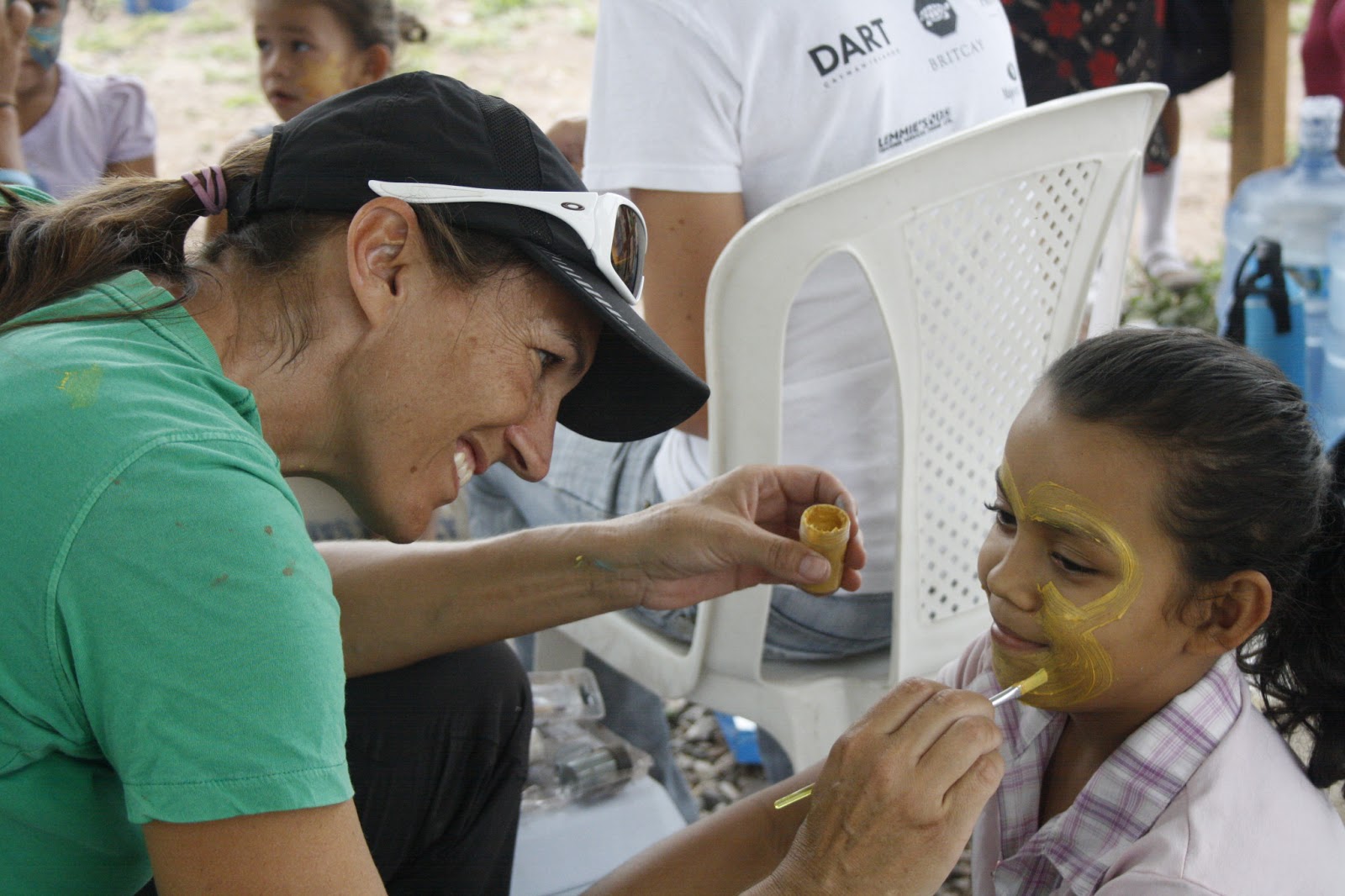
Tara Nielsen, Kimberly Parker & Genevieve Georgiades must've painted over 100 faces in just a couple days
The Work begins. Led by Mister Ray Jones of course. Omar Francis and our great missionary friend, Joe Denton.

I'm so proud of our team for taking advantage of both intentional and "surprise" opportunities to share the gospel. One afternoon we took bags of rice & beans and handed them out door-by-door along with a gospel presentation.
One boy, Orlando, found a bit of a crush on Genevieve Georgiades. I had to show him my wedding ring just so he'd stop forbidding me from talking with her.
Having allowed me to preach amongst his church body in Buffalo, Pastor Omar and I had a chance to visit his church facility whose roof was recently damaged. We raised enough money in offering to fix the roof!! Praise God!


Pinata Time. Things got nuts. Mad scramble for candy. One mother encouraged her daughter to go back into the mad scramble for more after she only retrieved a couple candies!


Helping Brother Ray complete the Sack Race - a great sport as always (and intense competitor)
Lovane (aka Coach Pelo) helping the kids succeed on the pitch

Sean Glidden entertaining us during some down time. He managed to survive.
Some of the completed work. Thanks to all who helped in the effort.

Puppet Show. Let's just say it wasn't a sell-out crowd for long...but we were grateful for "Di" "Si" & "Paul" to have made the journey from the Sunrise Children's Church all the way to Honduras.

Thank you all for your prayers. We really and truly sense their effectiveness! Please keep them up.


Monday, April 15, 2013

R.I.P. Brennan Manning (1934-2013)

I found out a couple nights ago that Brennan Manning died over the weekend. My response consisted of a few tears and a simple, "Thank you, Abba, for Brennan Manning."  
Manning was not the first to speak or write in great depth about knowing God as our "Abba" (an colloquial and familiar term for "father" in Aramaic, roughly translated to English as "PaPa" or "Daddy") nor was he the first to write about the wonder of God's grace or the relentless pursuit of God. However, he was my first teacher each of these concepts that have shaped my life even as they have since been distilled and refined through Holy Scripture, more steady theologians in history, and the invaluable gift of experiencing each of them through the Holy Spirit. 

Early on as new Christian, I searched for books to learn and know more in the first place I knew I could find them - the small bookshelf next to my parents' bed. It was there just a year before my university years that I stumbled upon The Ragamuffin Gospel by Brennan Manning. In his various literary works and through his speaking, Manning openly shares of his vast array of life experiences - his reluctance in entering priesthood to serving in the military, leaving the priesthood for the love of his life - Rosalyn, to the trauma of his alcohol addiction which later ruined his marriage to the same woman, spending six months in a cave in the Zaragoza desert to living among the poor with his Franciscan brothers. A summary of his zig-zag life can be found here on his official website.

As I reflected last night on his life, three impressions linger on my life:

1. You can learn and grow from someone you don't wish to imitate. The apostle Paul encourages the church of Corinth to "imitate me as I imitate Christ" (1 Cor. 11:1). There are and should be such actual persons that the Lord places in our lives whom we desire to largely (though not completely) imitate. Brennan Manning was not such a person. By all accounts his alcoholism - and specifically frequent omissions of its current toll on his life and lack of transparency toward those close with him regarding its pernicious stronghold on him - took his life. He drifted from the accountability structures and care he so needed from the local church - under the cloak of past hurts from Christendom's largest denomination. He brought significant hurt to his family. He often bordered on radical inclusivism that was far more broad than trust in Jesus alone for salvation and made many missteps when taking ethical stances on issues like homosexuality. BUT Manning was stubborn about grace (God's love made active through an undeserved gift) - both in his writings and his life. He fell a lot but kept getting back up off the mat. I learned that God not only loved me but liked me, that God had a deep and very personal love for sinners he liked to call ragamuffins (people who don't have it all together and are bumbling through life), I learned about a vast witness of various persons throughout history who had within them a testimony to the grace of God - Old English and modern fictional writers only found in history classes, obscure theologians and mystics from the middle ages, political leaders, modern teenagers who spoke better than they knew. A cast so wide-ranging and strange that I wondered if he made half of them up and then assigned to them wise quotes and awe-inspiring stories. 

This is a strange consolation to someone in my line of work. While I hope to someday be a person whose life is worth imitating, I don't think I'm there yet. However, I am confident my family, those closest to me, even the dear people of Sunrise whom I get to serve can even still learn and grow from me.

2. Manning was a flesh & blood reminder that the world is not my home. In 2000, I received the surprise gift of getting to go on a retreat weekend with Brennan Manning and a few other persons in Chapel Hill, North Carolina. It was a wonderful weekend! Each person had opportunity to sit down with Brennan for a kind of appointment. I made use of this opportunity as well as a late night in the den speaking with a few others present to pepper him with various questions about his writings, advice/counsel, more information on certain topics he discusses elsewhere only briefly. With each, Manning's answers were relatively pat and unusually resigned - all the while being as polite as possible. He had this look about him during that time (and others who have spent time with him on occasion confirm likewise) of wanting to be done with it. I am quite confident by this point he was wholly beset by his battle with alcoholism. Since then, every time I read these words I think of Manning:
For in this tent we groan, longing to put on our heavenly dwelling, if indeed by putting it on we may not be found naked. For while we are still in this tent, we groan, being burdened...we would rather be away from the body and at home with the Lord (II Corinthians 5: 2-4, 8)
Manning's closest spiritual kin was singer/songwriter Rich Mullins, who named his band The Ragamuffin Band after Manning's bestselling work. The two were very close. Manning, was so devastated by Mullins' young and untimely death that he couldn't bear up to show up and give the eulogy at his funeral. Rich Mullins was a bit of a human "misfit" -- socially awkward, ready even at the height of his fame to humbly ask to sleep on someone's sofa (he actually asked this of a friend of mine). He, thus, similarly at times seemed to be done with this life. 

I worry sometimes that this life and my lifestyle fits me too well, when my true home & citizenship lie elsewhere. These are two men remind me of a far greater future hope and reward that tends to motivate Christians less and less in an age whose average lifespan continues to trend upward. But more importantly it just makes Katie and I especially happy (and she said this to me last night) that Brennan in particular is with Jesus now. He looked forward to this day more than most.

3. The relentless pursuit of God through the grace of Jesus Christ. Manning wrote encouraged, exhorted and discipled me on this all-important, life-transforming, soul-satisfying subject during the formative years of my Christian life. 

My favorite Manning quote which I can still recite from memory: "The deeper we grow in the spirit of Jesus Christ the poorer we become - the more we recognize that everything in life is a gift and then the tenor of our lives becomes one of humble and joyful thanksgiving."

Thank you Brennan Manning for starting me down the road of recognizing both my true poverty and the great wealth I possess in Jesus Christ. And thank You, Abba, for Brennan Manning. 

Thursday, March 28, 2013

Hope: When do I keep fighting and when do I rest content?

Resurrection Sunday is drawing nigh. At SCC we'll be presenting the case for why the resurrection from the dead of a man named Jesus is the most defensible, possible and even plausible miracle in the Bible and worthy of one's belief. Please pray the Spirit begins working in the hearts and minds of those who attend (and whom you invite) even now to help them see for the first time to the truth and worth of this resurrected Savior. 

The resurrection from the dead is not only a Christian's but, deep down, any person's ultimate hope - that there is not only life beyond this life, but that life and even that physical body will be far more glorious than the present life and body which is subject to decay and whose end is death (Philippians 3:20-21). 

Equally, Jesus' resurrection from the dead gives us hope for the present life. It means Jesus is who he says He is - both God of the universe and our lives and the mediator between God the Father and mankind. 

So whenever I think of Easter I think of hope, which includes hope in God for the present to do big things in His church and through His will for me and my family. The apostle Paul expressed it this way in the midst of one of his most daunting trials: 

For we do not want you to be ignorant, brothers, of the affliction we experienced in Asia. For we were so utterly burdened beyond our strength that we despaired of life itself. Indeed, we felt that we had received the sentence of death. But that was to make us rely not on ourselves but on God who raises the dead. He has delivered us from such deadly peril, and he will deliver us. On him we have set our hope that he will deliver us again (II Corinthians 2:8-10)

Paul's internal calling & external circumstances provided a perfect place from which to ask one of the key real-life question pertaining to Hope: When do we keep hoping and fighting within a calling, for a dream, toward a goal and when do we rest content with circumstances look very much like God's settled will?

In his Nehemiah Notes, former pastor & experienced-bloke-who-has-walked-on-the-road-with-God Blaine Smith writes a very wise, insightful article on this question that's worth a read: CLICK HERE.

[Disclaimer: I do have a couple of small quibbles with the article. (1) Namely, I wish there was an explanatory section on the role of the Holy Spirit using His Word to shape, mold and form God-centered dreams and goals; (2) The frequent use of the word "potential." God absolutely has a full potential in mind for each of us in Jesus Christ and conforming us into His image (Rom 8:29). That word is so closely associated, however, with many self-help books and "Christian TV programs" which are actually quite man-centered. Overall, however, these quibbles don't outweigh the positives - the article is chalked full of wisdom and application from God's Word]

Monday, March 11, 2013

Forgiveness: You heard the sermon, now Sing the Song

Yesterday receiving the Word & responding in Worshipping under the big top, I had the privilege to teach on Step 4 in making relational peace between two persons. Step 4: Go & Be Reconciled (Matthew 5:23-24). My sermon in a nutshell was this: Don't miss your moment to cap-off the peacemaking process by verbally extending forgiveness.

I was searching all week for the perfect song that might complement the message and help us respond in praise and obedience to God's Word. Doh! Found it a day late. Chalk it up to God's will. Thanks to Susan Vivas who posted this song on her Facebook Page. It highlights nearly every point I wanted to make, did so through song, and did so in under 4 1/2 minutes (I know, I know: "If only Pastor Ryan had found this earlier vs. 35 minutes plus spilling Harquail pond water on the stage").

The song is "Forgiveness" by Matthew West.  Posting it here:


  • It's the hardest thing to give away...help me now do the impossible. Check.
  • And the last thing on your mind today. Check. One of the major reasons I showed clip of Mike Steenkamp (Reeva Steenkamp's uncle) extending forgiveness to his niece's killer (runner Oscar Pistorius). Because of the public spotlight & universal scope of the opportunity, it was easier for him not to miss his moment. But for us (and Jesus' audience in Matthew 5), the need to extend forgiveness is often the last thing on our minds and we, thus, so easily miss our moment.
  • It always goes to those who don't deserve. Check. Hey, just like each of us - who are ill-deserving of Jesus' forgiveness.
  • It's the opposite of how you feel. Check. Hence, replace feelings WITH ACTIONS and the story of my friend who mowed that dude's lawn even though his first inclination was to tear him a new one. Act and feelings will often follow. 
  • It takes everything, you just have to say the word. Check. When Jesus talks to his disciples about the power of forgiveness that He is entrusting to them (see John 20:22-23), the application for our lives is to actually speak these particular words: "I forgive you" versus offering a "no worries" - "no big deal" - "we're cool" response.
  • It'll clear the bitterness away, It can even set a prisoner free. Check. "Unforgiveness is the poison we drink hoping others will die" to quote Ken Sande formerly of Peacemakers Ministries. Letting it go frees us from the poisoning.
  • Help me now to give what You gave to me. Check. Ideally forgiveness comes as a natural response or overflow from considering, meditating on, cherishing, the forgiveness Jesus extends to us through his cross. "Bear with one another and, if one has a complaint against another, forgive each other; as the Lord has forgiven you, so you must also forgive" (Colossians 3:13).     
Awesome stuff. I've already bought the song to remind me of my need to forgive and then re-initiate forgiveness when total recall (the old grudge, desire for judgment) springs up when I least expect it. 

Thursday, March 7, 2013

YOU can help someone who is hurting

While Grand Cayman is both remarkably diverse in the six different continents with a strongly represented presence and assuredly contemporary in its features and amenities as compared with other Caribbean islands, we are still but a small-town population of only 55,000 persons...give or take (which is why I like to describe Cayman as an urban nation with a rural population).  

So when tragedy hits our small community, it often hits hard. A young man, just 15 years old, took his own life just a few days ago. And, as if that fact wasn't tragic enough, it seems that bullying directly precipitated this tragedy, as footage of the bullying act was posted and went viral. 

This has especially affected the Oelschlager family as we were afforded a small window into this young man's life. His best friend used to live across the street from us. Both were avid basketball players. And as a dear family had recently donated to us a basketball goal, they were over in our driveway a lot playing with Mason, Gage, and myself. The young man of whom I speak was especially and unusually kind, for a 15 year old male, to our boys. He would remember their names and even shoot hoops with them while I had to work on something in my adjacent office. We saw him last this past December at a basketball clinic. He bent down on one knee to say hi to Gage, whom he always called "Gabe" (understandably). Tears were shed, young questions were asked, & prayers were prayed at the Oelschlager dinner table this past Tuesday.

One of the local schools asked me to come in today to assist some particular students through grief counseling. There is never a time, even for a so-called "trained" pastor, when this is not a daunting challenge. But God's Spirit was sweetly present and ever gracious as I met back-to-back-to-back with a handful of young men.

Here's what I wish to share with you: Helping someone who is hurting isn't rocket-science. Just a little preparation, a tentative plan, and I lot of reliance on God. That's what it took today. Allow me to walk you through:

Preparation. Pretty simple prep. Two things. First, I remembered that in the midst of suffering, the goal is to point the person toward the only God of human history (and only purported God of any major religion) who became human and opened himself up to the worst that human suffering had to offer. Point the person to the God who has suffered - Jesus Christ. Second, I called to mind and prayed one of Jesus' precious promises to his disciples: "When you are brought before synagogues, rulers, and authorities, do not worry how you will defend yourselves or what you will say, for the Holy Spirit will teach you at that time what you should say" (Luke 12:11-12). It's good to think through a couple things but even more so to remember that the Holy Spirit wants to use us in these pressure-packed moments as we rely on Him.

Tentative Plan meets Holy-Spirit-helped Execution. Here's a basic outline of how I handled the conversations with teenage boys most of whom I had never really met.

1. To the hurting person: (a) Share with me a little of how you knew this person; (b) what are some memories of him that stick out to you?
>> I find this allows the hurting person opportunity to affirm out-loud the value and impact of the person's life. That their life was not in vain. 
>> This also helped me to share a little of my responses to these two questions.

2. Share a little yourself about valuing a life lost.
>> In this case, I had opportunity to share about how I valued the same person whom they loved. 
>> Especially in cases where you might not know the hurting person very well, the Spirit can use this I think to help earn the person's trust. They know you care and have a certain genuine depth of feeling also.

3. To hurting person: (a) Describe for me some of the feelings you are feeling. (b) Have you spoken with anyone else about these feelings?
>> Affirm the health of doing so if and when they have spoken to others.  

4. To hurting person: Everyone does something with their hurt, sadness or anger. Some bury it but it will cause them to harden, maybe become bitter. Some look for an escape: Perhaps partying; a hobby/activity/sport they can pour themselves into; or their work. What would you say are you doing with your hurt?

>> Bring Jesus into equation. 

5. To hurting person: You know if you haven't or feel like you can't talk with anyone else about how you are feeling or what you want to do about it, you can always talk to God. Especially the God of the Bible. Can I tell you why? The God described in the Bible is the only God who claims to have come down from his lofty throne in heaven to earth and suffered the worst pains of being human.  [I don't quote Scripture per say but give a few Bible facts in plain terms]

  • He's a God who was born into a people defined historically not by power nor by royalty but by their suffering (Hebrews/Israelites/Jews).
  • He's a God who was born into questionable circumstances - who's the father? (no human father, "illegitimate" birth).
  • He's a God who was immediately born into an assassination attempt upon his life (see Herod's killing off of all children in Bethlehem Jesus' age - Matthew 2).
  • He's a God who was betrayed by his friends, cursed by his enemies, and suffered the most painful and humiliating form of capital punishment known up to that point in history.
  • None of that equaled the punishment of suffering He took on for us. The just punishment each of us deserves for living life his/her own way not God's way. That's why Jesus died on a cross - he died in our place, the death we deserved.

6. PRAYER: Would you mind if we talked to Him now?
>> In prayer, I keep pointing to the God of suffering - whether it's the need know & trust Him as the person in front of me suffers, the reality that He understands what other loved ones not present are going through, or the forgiveness He offers even to those who caused His suffering (should there be persons involved in the matter at hand who bear some degree of blame and, thus, need forgiveness).

7. To hurting person: Is there anything else you feel you need to say or get off your chest?
>> So often God uses the prayer to soften the person to the point where now they wish to offer something more that they need to express. 
>> That certainly occurred today - and, through the prayer and the Holy Spirit urging me to follow-up with the above question, He may just have saved an angry young man from going down the path of becoming a bitter old man.

YOU too can be used by God to help someone who is hurting.

Wednesday, February 20, 2013

Free Audiobook for February: A Jesus-lovin' Indiana Jones

I have two sons - 8 and 6 years of age. The youngest celebrated his most recent birthday with a Spy Party (which included mostly parents jumping behind cardboard boxes shooting Nerf Gun Darts at one another...so, yes, the party was awesome!!). Boys, including this one in his mid-30s, gravitate toward adventure & risk. And there is plenty of that in the story of Brother Andrew.

God's Smuggler is a true story that begins with a boy who dreamed of one day being a spy and spent his childhood acting like one. After trusting his life to Jesus and seeing in His own life the impact of His Word, Brother Andrew decided to wed his life long passion with His passion for God's Word - spending decades smuggling Bibles across closed borders. The stories of God's supernatural protection and provision in the face of persistent imprisonment and death are astounding. 

You can download the free audiobook here. And as countless reviews tell of parents whose 7-10 year old children were riveted by this true account, my boys are likewise looking forward to hearing about the "Jesus-lovin' Indiana Jones" (don't judge me, but I'll use Harrison Ford-based media reference to lure my kids to the adventures found in living radically for Christ...okay, except for maybe Morning Glory).
I dare you to watch it!!


Friday, February 1, 2013

How do we know if God is disciplining us?

A former professor of mine at Trinity adroitly addresses a question that I have asked and still often do ask when things go sour in my life: Are these things happening because God is disciplining me for some offense or pattern of rebellion? How can I tell?

You can find the brief article here: "How do we know God is disciplining us" by D.A. Carson. (*note: he uses some fancy words & addresses pastors at times - but definitely well worth having to read a couple lines twice). 

I think his 3-part response covers all the bases nicely: 

(1) We must avoid, even in casual conversation about such issues, quoting one verse or alluding to one biblical story in trying to grapple with how to discern when discipline for sin is in play. I worry individuals tend to come from one extreme and quote whatever verse/story supports that - (a) God would never intentionally bring harm to me so it must be like Job where I just throw up my hands and learn to trust; (b) Like the Corinthians or those beloved sons spoken about in Hebrews 12, God is most certainly disciplining me for sin or a pattern of rebellion. 

(2) God's purposes in suffering and hard times are intricate and interwoven. I can think of a recent example of someone I know whose family member flew to her to accompany her on an airline trip due to a fear of flying she had. After touching down, that family member grew ill to the point where they had to fly to Miami for treatment. The person who had a fear of flying went with family member on to Miami and then to their final destination for treatment and subsequent care - all the while the fear of flying went away while accompanying the ill loved one. Now, was God's chief purpose in family member getting gravely ill (they are better now) to assuage and remove someone's fear of flying? Hard to say that. But what's not hard to say is it is a purpose - intricately interwoven into the multicolored tapestry that is God's plan.

(3) Why not examine our life and conscience? While no one wants to say it to the suffering friend, family member, co-worker, such suffering should give us an occasion to at least check the inner chambers. That's the first place we should look, but too often the last place we are willing to look.

Carson's conclusion at the end is on the money in my opinion: "The remedy is always the same: Flee to the cross." He's right. If the suffering is a form of loving discipline given in response to an act or pattern of rebellion, then we ought to flee to the cross to confess and receive Christ's unending forgiveness that will, then, empower us to change (that's what grace is: God's love made active through an undeserved gift). On the other hand, if the suffering can't be reduced to discipline but is more complex or seems to mysteriously involve no discipline at all, flee to the cross where we can find comfort in a God who did no wrong but willing suffered a hell far greater than we ever will - provided, of course, we trust in Him.