

Over at the Verge Network, Karen Hardin has relayed to us a fantastic, creative, and get-off-your-behind way to engage your child(ren) in prayer. Namely, as she puts it, you can use your child's tendency to see differences to foster gratitude and a habit of prayer. Who doesn't want to do that and who doesn't have a child who has complained "Brother, sister, Bobby, Sally has more/better ______ than me" ?!
Read here: "Turning Your Child's Focus Inside Out."
I will be trying to implement with our boys this week and can let you know how it goes. I can imagine this becoming a weekly prayer activity or maybe doing 1 or 2 of the ten "stations" per night along with regular worship & Bible Reading. Even though they are now getting a bit older, there are some nights my kids just have a hard time sitting - thus, this station-to-station idea may on such nice prove a nice alternative to exasperating "Ah, forget it, just go brush your teeth and get ready for bed."
May God use this wisdom to help your child engage with the God who can empower all of us to cease looking outward to compare but rather look outward to behold the goodness and glory of Jesus who can transform us toward love (II Corinthians 3:18).
Subscribe To

 Posts
All Comments
Wednesday, September 24, 2014


Thursday, September 18, 2014
Church-Branding Overwhelms the Cross
Jesus' object lesson in Mark 11:15-19 about the ineffectiveness of religious ritual continues to stir in me because I recognize that church attendance, just like temple worship in Jesus' day, can provide "a den" (a refuge, a hideout) for people to take cover under the banner of: "Me & God are good...because I'm a pretty good person who goes to church." Worse yet, those of us who are pastors, elders, or lay leaders are prone to propagate this twisted idea - even if unconsciously. Thus, the irony: We hurt the church we love by spending ourselves to promote the church we love. We ought not be about "our church" preservation and "our church" promotion - but Jesus-preservation (preserving his teaching) and Jesus-promotion (promoting His name).
 JR Kerr provides a "gut-check" to every church, including ours, in this little article: "Church-Branding Overwhelms the Cross." (A side note: I met JR Kerr at a Chicago Cubs baseball game - in the bleachers of Wrigley field. I kept in touch with him for a while and he helped me during a pivotal time in my ministry. A gracious and godly dude). His question toward the end is particularly challenging: "When people think of your church, what do you think they more readily think of, the cross or your brand?" Recently, a new Christian who attends our church turned to me and a friend and asked: "After all these years walking with God, how do you guys keep the fire going?" Let's just say neither of us respond firstly with: "A firm Commitment to our local church." Rather we replied similarly with: "A daily, return trip to the cross of Jesus Christ" (see Luke 7:47; II Corinthians 4:11; Galatians 2:20). Let's point people toward the fuel that will sustain the fire!
Why do people get so "my-church-promoty"? Various reasons I'm sure but one comes readily to mind: The Fear of getting left behind. Here are some fears that go to work on us who rightly love (but perhaps over-love) our church: "Is God moving in our church? If not, will others leave us for a newer and more exciting work? If He is working, I'm pretty weak and inadequate: Won't He choose to use others and leave me and my puppet ministry in the dust?" However, God promises a couple things concerning the local expression of His universal church - (1) He has every desire and motivation to advance and build His church (Matthew 16:18; Ephesians 2:22; 1 Peter 2:5) (2) He wants to use your God-given gifts to do so (Ephesians 4:7, 4:12-14).
I pray God uses your holding on with confidence to these two promises to free you and your church to be all about speaking and living the message of "Jesus Christ and Him crucified" (1 Corinthians 2:2) while letting Him take care of the advancing and the using. He says He will. He can be trusted to do so.
JR Kerr provides a "gut-check" to every church, including ours, in this little article: "Church-Branding Overwhelms the Cross." (A side note: I met JR Kerr at a Chicago Cubs baseball game - in the bleachers of Wrigley field. I kept in touch with him for a while and he helped me during a pivotal time in my ministry. A gracious and godly dude). His question toward the end is particularly challenging: "When people think of your church, what do you think they more readily think of, the cross or your brand?" Recently, a new Christian who attends our church turned to me and a friend and asked: "After all these years walking with God, how do you guys keep the fire going?" Let's just say neither of us respond firstly with: "A firm Commitment to our local church." Rather we replied similarly with: "A daily, return trip to the cross of Jesus Christ" (see Luke 7:47; II Corinthians 4:11; Galatians 2:20). Let's point people toward the fuel that will sustain the fire!Why do people get so "my-church-promoty"? Various reasons I'm sure but one comes readily to mind: The Fear of getting left behind. Here are some fears that go to work on us who rightly love (but perhaps over-love) our church: "Is God moving in our church? If not, will others leave us for a newer and more exciting work? If He is working, I'm pretty weak and inadequate: Won't He choose to use others and leave me and my puppet ministry in the dust?" However, God promises a couple things concerning the local expression of His universal church - (1) He has every desire and motivation to advance and build His church (Matthew 16:18; Ephesians 2:22; 1 Peter 2:5) (2) He wants to use your God-given gifts to do so (Ephesians 4:7, 4:12-14).
I pray God uses your holding on with confidence to these two promises to free you and your church to be all about speaking and living the message of "Jesus Christ and Him crucified" (1 Corinthians 2:2) while letting Him take care of the advancing and the using. He says He will. He can be trusted to do so.
Thursday, September 11, 2014
Kids & you Fathers that help raise them
I was just reading through an old journal earlier this morning and came across some thoughts in response to the Apostle John's poetic pronouncement of truth (it's not quite hymn/poem nor quite benediction/blessing) in 1 John 2:12-14. Here are the first two poetic pronouncements of truth:
Earlier this week, we had a night of hockey practice (yes, in the Cayman Islands...lots of wonderful Canadians live here and have brought their beloved hockey!!) and two different elementary school open houses to attend. Juggling the boys on my own at the hockey rink, I came across a decision Katie had made that didn't immediately "sit well" with me. I tend to wear my emotions on my sleeve and, while I didn't say anything, the boys detected that I was visibly upset. In between a little chaos here and there, Katie engaged in her own talk with God in the car and humbly apologized to me, which she didn't need to but her example deeply softened my heart. She proceeded to join her own open house where she is an Art Teacher while I set out on my own to engage our boys with our nightly family worship. We talked about the difference Jesus' forgiveness makes. I asked if they recognized Dad's anger earlier in the day: "Uh, yeah, your face told the story" said Mason. I had opportunity to share with them how their Mom responded: Humbly having already sought out and experienced God's forgiveness - and how her example impacted Dad. They both responded with smiles and snuggles (10 & 7 year old boys - getting increasingly rare) and with awe: "Man, Jesus can really do that, can't he?!" The forgiveness of Jesus breaking into real life absolutely captivated them such that we then had opportunity to talk more about instances in the gospels where Jesus humbly extends forgiveness and its softening impact on those who experienced it.
Fathers, remember you can know the One who has been a Father from the beginning. You feel the pressures of caring for a family. Thinking about what you are imparting to them, how to say it/impart it, their education now, their education years from now, balancing time in the office and your travel schedule with time at home. Furthermore, your responsibility for others, as a kind of father-figure, may extend outward over those in a small business, or providing direction for those who care for others. There is One who has been a Father from the beginning, who has cared for every need and been faithful to every promise for generations. He's had to stomach hard decisions: Kicking Adam & Eve out of the Garden; starting over through Noah; keeping Moses from the promised land, withholding the temple building project from David who dreamed it, and not taking from Jesus the bitterest cup of just wrath -- and all the ones in between both in the Bible and since. All along He's watched each decision profit the person, His people, and His name. He knows. Learn from Him, stay near to Him.
I love you, fathers. God is using you! Keep fighting the good fight as you hold out to your kids the forgiveness of Jesus and hold fast to the faithful Father of every generation.
I am writing to you, little children, because your sins are forgiven for his name's sake, I am writing to you, fathers, because you have known him from the beginning.Fathers, consistently confront your children with the life-altering forgiveness of Jesus - because children have a unique ability to utterly self-forget and focus outward when first awestruck. What happens then at being awestruck? They are able to learn about Jesus without the jaded cynicism, without the colored past that colors our view of Jesus and what we like best about him, without the pressures of adult life that aims to get what we wish to get out of Jesus. When they discern and acknowledge the "Big No" in their own hearts called sin and make the connection to Jesus the Rescuer - they camp out on that bridge! It becomes all about "his name's sake" and there is no other season like this in their lives.
Earlier this week, we had a night of hockey practice (yes, in the Cayman Islands...lots of wonderful Canadians live here and have brought their beloved hockey!!) and two different elementary school open houses to attend. Juggling the boys on my own at the hockey rink, I came across a decision Katie had made that didn't immediately "sit well" with me. I tend to wear my emotions on my sleeve and, while I didn't say anything, the boys detected that I was visibly upset. In between a little chaos here and there, Katie engaged in her own talk with God in the car and humbly apologized to me, which she didn't need to but her example deeply softened my heart. She proceeded to join her own open house where she is an Art Teacher while I set out on my own to engage our boys with our nightly family worship. We talked about the difference Jesus' forgiveness makes. I asked if they recognized Dad's anger earlier in the day: "Uh, yeah, your face told the story" said Mason. I had opportunity to share with them how their Mom responded: Humbly having already sought out and experienced God's forgiveness - and how her example impacted Dad. They both responded with smiles and snuggles (10 & 7 year old boys - getting increasingly rare) and with awe: "Man, Jesus can really do that, can't he?!" The forgiveness of Jesus breaking into real life absolutely captivated them such that we then had opportunity to talk more about instances in the gospels where Jesus humbly extends forgiveness and its softening impact on those who experienced it.
Fathers, remember you can know the One who has been a Father from the beginning. You feel the pressures of caring for a family. Thinking about what you are imparting to them, how to say it/impart it, their education now, their education years from now, balancing time in the office and your travel schedule with time at home. Furthermore, your responsibility for others, as a kind of father-figure, may extend outward over those in a small business, or providing direction for those who care for others. There is One who has been a Father from the beginning, who has cared for every need and been faithful to every promise for generations. He's had to stomach hard decisions: Kicking Adam & Eve out of the Garden; starting over through Noah; keeping Moses from the promised land, withholding the temple building project from David who dreamed it, and not taking from Jesus the bitterest cup of just wrath -- and all the ones in between both in the Bible and since. All along He's watched each decision profit the person, His people, and His name. He knows. Learn from Him, stay near to Him.
I love you, fathers. God is using you! Keep fighting the good fight as you hold out to your kids the forgiveness of Jesus and hold fast to the faithful Father of every generation.
Monday, August 11, 2014
An Unlikely match: Fearing & Loving God at the same time (PART 2)
 Welcome to Part 2 (Part 1 here). To summarize Part 1: (a) Most Christians tend toward either fearing or loving God, but certainly not both at the same time (b) Fear, by nature, is consuming - specifically feasting on your thoughts so it can get fatter and take up more space first in your mind, then trickle into your values & priorities (your heart) & then outward from your will (your actions); (c) The Fear of God is different, it is equally thought-consuming but, unlike other fears, it is life-giving. So you can fear and love God at the same time. Having looked at the apostle Paul's conception of the terrible mercy and merciful terror of God in Romans 8, let's turn back the Bible clock and look at Psalm 130...
Psalm 130. This is perhaps my favorite Psalm (though Psalms 27, 77, and 139 are strong candidates). If you read this post and are somewhat inspired to begin simultaneously fearing and loving God, memorizing Psalm 130:3-4 would be a great place to start:
If you, O LORD, should mark iniquities (ie. sin), O Lord, who could stand? But with you there is forgiveness, that you may be feared.
Here we have described in two verses what Paul was describing with a lot more ink & parchment. The psalmist, who has no doubt fretted and feared just as he has endured real and potential harm in his life, now awaits a solution to His biggest problem. God marks sin in His holy ledger and none can stand without a solution. All will fall. But the psalmist anticipates a future solution:
I wait for the Lord, my soul waits; and in his word I put my hope; My soul waits for the Lord, more than watchmen wait for the morning, more than watchmen wait for the morning (Psalm 130:5-6)
Watchmen on the wall knew their shift was over and the danger of invasion had passed when the morning came. Morning always came - but, without timepieces, they just didn't know when that first sign of dawn would lighten the sky. Similarly, the psalmist is confident a solution will come...he just doesn't know when. That solution to falling, justly, into the abyss of God's eternal judgment will be complete and total.
O Israel, put your hope in the LORD. For with the Lord there is steadfast love, and with him there is full redemption. He will redeem Israel from all his iniquities (Psalm 130:7-8)
As with Paul, the psalmist is in touch with his greatest potential harm - full, awful, wrath-filled, just condemnation for a heart and life that daily rebels against its Creator. His default posture when considering how he will one day answer to God: Can't even stand! Full redemption and forgiveness come through Christ..."that you may be feared" (v.3). He wants to consume our thoughts with this wonderful deliverance. The fear of God is the only fear that doesn't lead to all its negative implications (worry, self-protection, insulation, flight) though the God is the greatest potential threat & destructive force we will ever encounter. We currently know and relate to the same God from whom we deserve the fulfillment of eternity's worst fear, a real fulfillment that we still be executed for some (ie. the same God who is no less wrath-potent & will execute the fullness of his just wrath once more), yet not for us who trust Christ because He consumed it on our behalf. This is the terrible mercy/merciful terror designed to grow larger as it consume all thoughts - thus crowding out all smaller and earthly fears. Unlike the others which robs your time, shrinks your trust toward others, and spends time (unlike every other fear) life-giving.
So in summary: The Fear of God is all-consuming, ever-growing thinking whose central refrain is: "I relate, respond to, worship a God who is terror-potent with a wrath-promise...just not toward me because Jesus mercifully absorbed the wrath I deserved" and with the result that every other earthly fear must shrink in comparison to the growing Fear, such that earthly fear will cease limiting bold acts of faith done out on the ledge of life.
A Way to Enter into simultaneous fear & love: Sometimes we have to enter into something new by way of what's familiar - via an illustration or a word-picture that relates more concretely to our lives. Jesus did this all the time when he related truth through parables. His listeners could thereby enter into His truth by the familiar ways of the agricultural, familial, or economic venues which daily inhabited.
If you would then, take a moment to approach your largest fear which contains potential harm. And what if I could guarantee for you, that thing you fear will cause others harm in the future. Yet as you approach it, without losing it's potential for harm, it just keeps on not harming you. Could you stand to remain near it? Would you not be compelled and drawn, yet wide-eyed and perspiring all the while? I mentioned some possible examples in my first post:
A tarantula that sits on your knee but never does bite you.
A viper that has slithered up your shirt sleeve but never strikes.
Saying something conspicuously embarrassing in front of group of people but they never turn to gawk nor give the slightest laugh at your expense. $1 in your savings account but despite your spending, that dollar never runs out.
Standing on the edge of a cliff, now walking, now dancing, but never teetering nor toppling over the edge.
I trusted my life to Christ and later worked at a International Christian sports camp in the
foothills of North Carolina. I met lifelong friends there including Katie, my wife. We would occasionally get to spend time 'off-campus' - usually during a day off or with a smaller group of remaining campers from the previous week's session. One off-campus place to which my friends and I would often go is nearby Pilot Mountain. We'd take food out there, go hiking, and tool around for a while. Most of my friends especially enjoyed hanging their feet over the edge of the precipitous fall. The only way I could get near the edge is by way of "army crawl," which if you are not familiar: Front of the entire body making contact with the ground while inching forward using only your forearms (thus minimizing risk of the accidental "trip," "stumble" or "slip"). Hearty laughter often abounded as I slowly crawled my way into a conversation.
I must say it was a spiritual if not darn near "mystical" experience that led to the writing of these two posts (but I think this subjective experience lines up with the objective, biblical concept of the simultaneous fear and love of God). In prayer one day, I sensed the Holy Spirit beckon me to the ledge of that same cliff to which I used to crawl - along with the invitation: "Come learn what it means to fear me." After approaching the edge of the cliff on my feet: "If you trust me to keep you from falling, walk along it" and, then, "Run!" All of this played out in my mind's eye. Even though I was safely in my backyard with two feet on the ground, I was sweating through my shirt at 7 am. I think God put me through this spiritual exercise to help me appreciate truly approaching and relating to Him. If I call Him Savior, make no mistake He is saving me from something real and terrible. If I can expect a warm and Fatherly embrace, I must walk to the edge of the abyss to get it.
If you would then, take a moment to approach your largest fear which contains potential harm. And what if I could guarantee for you, that thing you fear will cause others harm in the future. Yet as you approach it, without losing it's potential for harm, it just keeps on not harming you. Could you stand to remain near it? Would you not be compelled and drawn, yet wide-eyed and perspiring all the while? I mentioned some possible examples in my first post:
A tarantula that sits on your knee but never does bite you.
A viper that has slithered up your shirt sleeve but never strikes.
Saying something conspicuously embarrassing in front of group of people but they never turn to gawk nor give the slightest laugh at your expense. $1 in your savings account but despite your spending, that dollar never runs out.
Standing on the edge of a cliff, now walking, now dancing, but never teetering nor toppling over the edge.
I trusted my life to Christ and later worked at a International Christian sports camp in the
 |
| Pilot Mountain: God hath redeemed the thought of you. |
I must say it was a spiritual if not darn near "mystical" experience that led to the writing of these two posts (but I think this subjective experience lines up with the objective, biblical concept of the simultaneous fear and love of God). In prayer one day, I sensed the Holy Spirit beckon me to the ledge of that same cliff to which I used to crawl - along with the invitation: "Come learn what it means to fear me." After approaching the edge of the cliff on my feet: "If you trust me to keep you from falling, walk along it" and, then, "Run!" All of this played out in my mind's eye. Even though I was safely in my backyard with two feet on the ground, I was sweating through my shirt at 7 am. I think God put me through this spiritual exercise to help me appreciate truly approaching and relating to Him. If I call Him Savior, make no mistake He is saving me from something real and terrible. If I can expect a warm and Fatherly embrace, I must walk to the edge of the abyss to get it.
As I was working on this posts, I did have a couple days where I thought I might be a little 'out there' with my understanding of the fear of God. So I was exceptionally grateful at that point to hear the idea of such an edgy approach to God so similarly advocated by an older and wiser pastor whom I esteem so highly (note especially: Grand Canyon):
Fear and trembling are not because God is our enemy but because He saved us from His wrath through Christ, and now we stand on the brink of the Grand Canyon of His holiness and justice and grace and wrath with unspeakable wonder, knees wobbling and hands trembling, but overcome with worship at the depth of his majesty, not with worry that we might fall in (John Piper, "The Present Effects of Trembling at the Wrath of God," March 6, 2005).
What does a simultaneous fear & love of God do? 1. Solves the problem of trying to 'get' ourselves to fear God. It's not something you start doing, it's something you start thinking. You don't get rid of fear - you replace it. So utilize the one life-giving fear available to you. 2. Helps us better discern our design. You can start to tell we were designed for fear. We are made to be filled full with fear (Ps. 139:14). As a good friend pointed out to me over lunch this week: There are activities in this world which we both love and fear and so "hint" at our design. Sky-diving (death), gambling (loss of money), a suspense murder mystery (heart attack?), game hunts/safaris (loss of limb or worse), roller-coasters (loss of lunch). All involve real and potential harm...and toward us. But what a rush! We are designed to live out on the edge. That begins with our relationship with God, who is full of potential and again-to-be-deployed wrath...just not toward us who trust Christ. 3. Fear & Love are wed. All those verses about trembling with joy and delighting in fear (see Psalm 2:11; Isaiah 11:3; Nehemiah 1:11). The only way to access this is through fearing the God of the gospel. That we are teetering toward the abyss of eternal torment and only the merciful hand of God keeps us out. "Thank you and wow!" Might such be our forever response. "Thank you and wow!" Awestruck & Lovestumped. 4. Empowers you for more and bolder faith-risks. The more we meditate on this unseen reality, the more we are emboldened for faith-risks on the edge of life because thoughts of their potential harms shrink as the fear of God grows larger. This doesn't happen overnight and I'm not sure you wake up one day and everything else is just "whatever bad happens, no biggie" (I'm not sure because this journey of fearing God is something to which, in some ways, I'm still pretty new).
This edgy, terrible mercy/merciful terror nature of God is something we must neither simply give mental assent nor be satisfied to experience only on special occasions, but daily meditate upon, soak in, and keep before us if we are ever to fear and love God at the same time.
This edgy, terrible mercy/merciful terror nature of God is something we must neither simply give mental assent nor be satisfied to experience only on special occasions, but daily meditate upon, soak in, and keep before us if we are ever to fear and love God at the same time.
Thursday, August 7, 2014
An Unlikely match: Fearing & Loving God at the same time (PART 1)
A tarantula that sits on your knee but never does bite you.
A viper that has slithered up your shirt sleeve but never strikes.
Saying something conspicuously embarrassing in front of group of people but they never turn to gawk nor give the slightest laugh at your expense.
Standing on the edge of a cliff, now walking, now dancing, but never teetering nor toppling over the edge.
$1 in your savings account but despite your spending, that dollar never runs out.

That's where we will end up. Such paradoxical illustrations will reappear at the finish line as I seek to unwind what is an explicitly biblical mystery of how a true Christian both simultaneously fears and loves God. And how it changes them...
The Problem: Either fear or love of God likely bothers you, even if just a little (& certainly trying to both at the same time!).
 1. What fear is and what fear does. I would define fear as a deep-seated emotion toward some potential harm, the growing thoughts of which causes a person to remain distant, protect, or run. Fear is not inherently evil but neutral because the potential harm is, in fact, real. However, the fears that cause us to remain distant, protect ourselves at every corner and run, turn negative when we've fed such fear with more and more of our thoughts such that it has grown inordinately large. Hence, what fear does. Fear consumes thoughts. Anxiety, worry, fears become inordinately large because we think on them. We imagine the possibilities of life ruined by them, we mull over our past hurts related to it, we consider a news item, a doctor's warning, or anecdote your friend told you and begin to think of the consequences should the potential harm become actual. Fear feeds on our thoughts. Such that whatever potential harm we think on most, that becomes our largest (or fattest) fear. And Fear never stops eating on it's own. In fact, it goes on to consume our priorities & values (heart) and then finally eats out to our will & actions (behavior) [see horribly-rendered drawing above].
A viper that has slithered up your shirt sleeve but never strikes.
Saying something conspicuously embarrassing in front of group of people but they never turn to gawk nor give the slightest laugh at your expense.
Standing on the edge of a cliff, now walking, now dancing, but never teetering nor toppling over the edge.
$1 in your savings account but despite your spending, that dollar never runs out.
That's where we will end up. Such paradoxical illustrations will reappear at the finish line as I seek to unwind what is an explicitly biblical mystery of how a true Christian both simultaneously fears and loves God. And how it changes them...
The Problem: Either fear or love of God likely bothers you, even if just a little (& certainly trying to both at the same time!).
- There is the love of God. Intimate, faithful, other-delighting, vulnerable love. We are told: "There is no fear in love, but perfect love casts out all fear, for fear has to do with punishment. Whoever fears has not been perfected in love" (1 John 4:18). Fearing God would mean that I'm worried at any moment, depending on an inward thought, an outward action, or just the fact that I'm not naturally a good person on the inside, He might just leave or even throw some wrath my way. People who tell me "to fear God" need to creep on out of the Old Testament!
- There is the fear of God. Reverential, trembling, awestruck, gulping, "can't...really...talk...right...now" fear. We are told: "The fear of the LORD is the beginning of wisdom/knowledge" (Proverbs 1:7). Treating God (or "buddy Jesus") like the bloke I most want to have a drink with after work or person with whom I want to plan my baby/bridal shower is not a God worthy of my worship. People who say: "Jesus is my homeboy/bestie" should probably turn off Christian radio and spend a month in the Book of Revelation. He is the Almighty, the King, our Judge.
But these two crazy kids belong together. The Bible almost inexplicably weds the two ideas and more often than the appearance of the occasional proof text (see 1 John 4:18 above) used to prove the other side wrong. Consider the following appetizers:
- Psalm 2:11: Serve the LORD with fear and rejoice with trembling.
- Isaiah 11:3: And his delight shall be in the fear of the LORD.
- Nehemiah 1:11: O LORD, let you ear be attentive to the prayer...of your servants who delight to fear your name.
The Game Plan. How might we arrive at such an awestruck & lovestumped kind of life? It is upon this question I've been reflecting considerably. First, we need to reevaluate what fear is and what fear does. Second, armed with what fear does to us, we will learn how fear and love are wed such that the fear of God becomes functional and life-giving (unlike every other fear which is offers no return on time & energy invested & is utterly debilitating) Third, we'll delve into how such a fear changes how we relate to God and the world around us. It also turns out that God has been teaching me so much on this these past couple weeks or so that this will be Part One of a Two-part effort.
1. What fear is and what fear does. I would define fear as a deep-seated emotion toward some potential harm, the growing thoughts of which causes a person to remain distant, protect, or run. Fear is not inherently evil but neutral because the potential harm is, in fact, real. However, the fears that cause us to remain distant, protect ourselves at every corner and run, turn negative when we've fed such fear with more and more of our thoughts such that it has grown inordinately large. Hence, what fear does. Fear consumes thoughts. Anxiety, worry, fears become inordinately large because we think on them. We imagine the possibilities of life ruined by them, we mull over our past hurts related to it, we consider a news item, a doctor's warning, or anecdote your friend told you and begin to think of the consequences should the potential harm become actual. Fear feeds on our thoughts. Such that whatever potential harm we think on most, that becomes our largest (or fattest) fear. And Fear never stops eating on it's own. In fact, it goes on to consume our priorities & values (heart) and then finally eats out to our will & actions (behavior) [see horribly-rendered drawing above].
You can see how this begins to relate us to God. He has made us to function with fear (we are not just wonderfully made, made to fill full with wonder, but fearfully also, made to fill full with fear - Psalm 139:14). We want Him to become largest in our minds, our all-consuming love that we sing about, teach about, tell our lost friends about, write Facebook posts about, and influences every thought and action. So combining God and fear would be great because Fear never stops eating on its own - grows in our minds, down toward our hearts & outward through our actions. Except that fear always thinks on potential harm and fear, as we normally experience it, would cause us avoid, protect, run. Not to mention the Bible affirms God is the greatest potential harm and destructive threat we will ever encounter. Jesus told us bluntly: "And do not fear those who can kill the body but cannot kill the soul. Rather fear Him who can destroy both body and soul in hell" (Matthew 10:28).
2. How is the fear of God different from every other fear? How does God get larger in our minds without simultaneously avoiding Him altogether in fear or living ever-cautiously like He is ready to bring down the hammer with any false move on our part? How can God consume our thoughts with His largeness without also putting aside His tender, humble and secure love? What I am going to share is nothing more than the gospel. However, it's the gospel with an edge. Those who sit under my preaching have heard me say frequently: The greatest gift of the gospel is God. Through trust in Jesus Christ, you are reconciled to the Father who created you. You get God! But it's not a God who has thrown out wrath, terror, divine justice for mercy only; nor is it a God who shows to us only one face - the sweet lamb face and not the lion. Every time we approach God and relate to God (even now!) He is lamb and lion. The real, three-personed God puts us on the edge with HIm - the edge between just wrath and tender mercy - and empowers us to live with emboldened faith on life's edges as we begin to really fear Him.
There are two places in Scripture I've turned to most frequently when I worry, grow anxious, even fear. One is the Book of Romans, where I find a bedrock of truth regarding my firm standing with God secured by Christ through faith. The other is the Psalms where my fears find a voice and a God who speaks to them. It is in these two places where the Holy Spirit has helped me grow in simultaneously fearing and loving God. Let's look together first at Romans 8.
Romans 8. Romans 8:31: "What then shall we say to these things? If God is for us, who can be against us." That Scripture has given many of us great comfort and emboldened us to step out in faith - for a business meeting when a promotion or our very job was on the line, for trying something, getting up the nerve to pop a question of great import, saying "no" to people who've never heard you say that, for the courage just to get out of in bed, and to speak up for Jesus. Now the Apostle Paul did step out in faith to do some or most of the above (though it was likely 40 lashes minus 1 and not depression that made it hard to get out of bed). Yet none of these gave cause to Paul writing this courageous battle cry. Deliverance from the just condemnation and wrath of God was Paul's supreme reason for bold living. I say this for two reasons. Just a couple sentences later:
Who is to condemn? Christ Jesus is the one who died - more than that, who was raised - who is at the right hand of God, who indeed is interceding for us. Who shall separate us from the love of Christ? Shall tribulation, or distress, or persecution, or famine, or nakedness or danger, or sword? (vv.34-35).
There was only One who can condemn and who still condemns but will no longer do so toward the lawbreaker who trusts in the Jesus - who bore the full weight of the condemnation on our behalf (what the Bible calls propitiation; see Romans 3:25; Hebrews 2:17; 1 John 4:10). "If God is for us, who can be against us" and the glorious section describing the Christian's essential invincibility to follow is the end of one long thought that began in v.1 of chapter 8. In fact v.1 of chapter 8 is the undisputed turning point of Romans that separates chapters 1-7 and 8-16. Paul has just described justification by faith in chapter 6, the ongoing presence of sin in chapter 7 and ends that chapter describing his ongoing struggle with sin. In a word, he expresses fear - fear that he'll never be done with sin. Then chapter 8, verse 1.
There is therefore no condemnation for those who are in Christ Jesus.
 |
| The most eternal fear & greatest love: Both present at the cross. |
All other worldly fears dissipate because there is no longer fear of condemnation. The condemnation is still real because it fell on Jesus and because there is still condemnation to come for those in the world who do not trust Jesus to make them right with the Father...just no longer toward Paul. This liberating truth consumes Paul's thought. You can feel it escalating with every word in Romans 8! Out of awestruck gratitude & armed with every-moment access to a God of both merciful & terrible power, he risks all manner of potential harm for the glory of Jesus. Potential harm like tribulation, distress, persecution, famine (ie. not eating for days), danger, sword... even nakedness. His earthly fears shrink or are "crowded out" now that this new Fear expands even as it consumes most every thought.
Paul can teeter on any earthly edge precisely because He has/is teetering on the edge - between merciful eternal life with God and holy, just, divine judgment (again, it's the same God) and yet remains supremely confident he will never topple into it. This thought has so consumed Paul's mind that any bold act with the potential to harm - things present, things to come, demons, rulers, and spiritual powers of the gnarly sort (Rom 8:38-39) - are mere child's play by comparison.
In Part 2 (here), l share about Psalm 130, speak to how the fear of God transforms us, & finally explain the spider/snake/ledge/$1 bank balance...
Monday, August 4, 2014
Fear Not: Series of Blog Posts
 Howdy friends. Hope you are having a fantacular summer. I just got back from our annual holiday-polooza across the Southeastern part of the United States (including a trip to its capital Washington, D.C. -- admittedly, to visit with close friends but with the excuse that our little American citizens should learn some American history whilst living abroad).
Worshipping Sunday with my local family of faith and diving together into His Word was a breath of fresh air. I have just started a 3-week series entitled Fear Not which aims to lay out 3 anchoring truths designed to move people (including this guy) from fear to faith.
Sooo...the Sunday messages are intended to be more prescriptive than diagnostic in nature (ie. spending less time on WebMD figuring out how fear works & its symptoms and more time going to the Physician for truth prescriptions). Nevertheless, taking time to look at some of the inner workings of fear can help ready us to fight against it.
Each week of the series I'll write a blog post, during which time I'll take a poke at the following:
- An unlikely match: How Fearing & Loving God go together
- An 'acceptable' weakness: The fear of man
- The straw that stirs the fear: Worldly & Satanic lies
- Stranger Danger: When fear is good
I'm already working on the first, but having a hard time choosing 2 out of the remaining 3. If you have any thoughts or preferences, do please let me know (or would that constitute me "fearing man"?!...chuckle...ridiculous).
Will report back soon.
Wednesday, May 28, 2014
Matthew 5: Jesus says, Jesus does
The majority of Community Groups in Sunrise are following up outreach through the Christianity Explored course & dinners by imparting a very simple and memorable discipleship strategy to new/young believers. We are engaging with the major events and teachings of God's Word (from Genesis to Revelation) while learning together how to feed ourselves with God's Word and how to teach others to do likewise.
Last week the five guys within our larger group were working through sharing a 'lightbulb' moment that God gave each of us as we read Matthew 5. As we did so, God opened my eyes to something I had never before seen.
Jesus, in the wisdom that typified his every parable and pericope, is teaching at 2 levels here and we'd do well to pay attention at both levels. Jesus speaks to his disciples many high ethical standards for them to live out or embody - but (lightbulb!) he speaks of himself doing just one thing.
Level 1: Jesus speaks - high heart standards. "And he opened his mouth and taught them, saying" (v.2) is how Jesus begins and this continues for 9 Beatitudes (happy promises), 2 lofty embodiments (salt of the earth & light of the world), and 6 of the loftiest moral standards I've ever heard - all of which begin with the formula: "You have heard that it was said...but I say to you." As we discussed anger tantamount to murder, living through unhappy marriages, looking at a woman that second time with the wrong intent, loving those you feel you should probably just avoid because they press all your buttons - the consensus amongst these 5 men in our little group: "They must have shook their heads in defeat as Jesus went through each of these one by one." On the one hand, each of these ratcheted-up standards are for our good. For example, When we allow anger to fester and grow at the heart level, the other person becomes, in effect, dead to us (Mt. 5:21-22) so it is worth leaving even a worship service to do the hard and humbling work of reconciliation (Mt. 5:23-24). On the other hand, the further Jesus goes up the list, the more one feels his/her inability - not striking back when struck, given more than what a mooch might ask for, love and pray for those who wish you ill?!
Then the kicker - Jesus teaches we are to do and not relax any of these commandments (Mt. 5:19), our righteousness must exceed a group of persons who had spent their lives and quit their jobs (in some cases) to dedicate themselves to meticulous obedience to every law and every possible way to obey it (Mt. 5:20), and he concludes: "You therefore must be perfect as your heavenly Father is perfect" (Mt. 5:48). Jesus means for us at this point, I believe, to feel our utter inability.
So to re-cap so far, Level 1: Each of these individual "doing what's right" would serve us and others well - while brining great glory to God. The bridge: We are meant to feel the impossibility of actually doing them.
 Level 2: Jesus does. Did you ever notice that for all the speaking, teaching, and "but I say to you's" from Jesus in Matthew 5, there is only 1 thing he says he will do? And it's the one thing we absolutely need! "Do not think I have come to abolish the Law or the Prophets (ie. the entire Old Testament); I have not come to abolish them but to fulfill them. For truly, I say to you, until heaven and earth pass away, not an iota, not a dot, will pass from the Law until all is accomplished" (Mt. 5:17-18).
The word translated "fulfill" (pleroo) really does give a sense of "fills full." Imagine the Old Testament as a large bucket not yet filled to the brim. Jesus fills full the entire Old Testament where it lacks: (a) All the Messianic prophecies that are left open; (b) All the types of leaders/deliverers who didn't quite live up to God's standard (Moses, David, Aaron, Joshua, and every prophet-priest-king); (c) All of the Law and commandments -- moral law: Jesus does it; ceremonial law: Jesus becomes the sacrifice; civil law: Jesus is exalted as the ruling king worth submitting to.
For our immediate purposes, Jesus perfect living fills full the bucket of where we fall woefully short (cf. Matthew 3:15). So he offers to credit to us his filled-full righteousness by simple trust in Him.
Jesus Level 2 fulfillment then empowers us to live out his Level 1 standard. When we trust in Him, He causes us to be born again (John 3:7-8), giving us a new and tender heart that wishes to please our Father (Ezekiel 36:26), so tender that the high-heart standards will be permanently etched onto our hearts (Jeremiah 31:33). The great 20th century German theologian (and martyr) Dietrich Bonhoeffer put it well in The Cost of Discipleship in which he examines Jesus' sermon on the mount. He says with respect to chapter 5 of Matthew's gospel:
Last week the five guys within our larger group were working through sharing a 'lightbulb' moment that God gave each of us as we read Matthew 5. As we did so, God opened my eyes to something I had never before seen.
Jesus, in the wisdom that typified his every parable and pericope, is teaching at 2 levels here and we'd do well to pay attention at both levels. Jesus speaks to his disciples many high ethical standards for them to live out or embody - but (lightbulb!) he speaks of himself doing just one thing.
Level 1: Jesus speaks - high heart standards. "And he opened his mouth and taught them, saying" (v.2) is how Jesus begins and this continues for 9 Beatitudes (happy promises), 2 lofty embodiments (salt of the earth & light of the world), and 6 of the loftiest moral standards I've ever heard - all of which begin with the formula: "You have heard that it was said...but I say to you." As we discussed anger tantamount to murder, living through unhappy marriages, looking at a woman that second time with the wrong intent, loving those you feel you should probably just avoid because they press all your buttons - the consensus amongst these 5 men in our little group: "They must have shook their heads in defeat as Jesus went through each of these one by one." On the one hand, each of these ratcheted-up standards are for our good. For example, When we allow anger to fester and grow at the heart level, the other person becomes, in effect, dead to us (Mt. 5:21-22) so it is worth leaving even a worship service to do the hard and humbling work of reconciliation (Mt. 5:23-24). On the other hand, the further Jesus goes up the list, the more one feels his/her inability - not striking back when struck, given more than what a mooch might ask for, love and pray for those who wish you ill?!
Then the kicker - Jesus teaches we are to do and not relax any of these commandments (Mt. 5:19), our righteousness must exceed a group of persons who had spent their lives and quit their jobs (in some cases) to dedicate themselves to meticulous obedience to every law and every possible way to obey it (Mt. 5:20), and he concludes: "You therefore must be perfect as your heavenly Father is perfect" (Mt. 5:48). Jesus means for us at this point, I believe, to feel our utter inability.
So to re-cap so far, Level 1: Each of these individual "doing what's right" would serve us and others well - while brining great glory to God. The bridge: We are meant to feel the impossibility of actually doing them.
Level 2: Jesus does. Did you ever notice that for all the speaking, teaching, and "but I say to you's" from Jesus in Matthew 5, there is only 1 thing he says he will do? And it's the one thing we absolutely need! "Do not think I have come to abolish the Law or the Prophets (ie. the entire Old Testament); I have not come to abolish them but to fulfill them. For truly, I say to you, until heaven and earth pass away, not an iota, not a dot, will pass from the Law until all is accomplished" (Mt. 5:17-18).The word translated "fulfill" (pleroo) really does give a sense of "fills full." Imagine the Old Testament as a large bucket not yet filled to the brim. Jesus fills full the entire Old Testament where it lacks: (a) All the Messianic prophecies that are left open; (b) All the types of leaders/deliverers who didn't quite live up to God's standard (Moses, David, Aaron, Joshua, and every prophet-priest-king); (c) All of the Law and commandments -- moral law: Jesus does it; ceremonial law: Jesus becomes the sacrifice; civil law: Jesus is exalted as the ruling king worth submitting to.
For our immediate purposes, Jesus perfect living fills full the bucket of where we fall woefully short (cf. Matthew 3:15). So he offers to credit to us his filled-full righteousness by simple trust in Him.
To the one who works [to be perfect & fill full his own bucket of right-living], his wages are not counted as a gift but as his due. And to the one who does not work but trusts in Jesus who justifies the ungodly, his faith is counted as righteousness (Romans 4:4-5).So here in Matthew 5, Jesus is giving us a high-heart ethical standard that is meant to be lived out for our good and the good of our neighbor; yet, he's also purposely set the standard so high that we are meant to feel our inability - so he hints here at one thing he will do: Fill full all righteousness and right-living that we could not - including willingly becoming the right sacrifice to fulfill the Law and becoming our rightful king by way of resurrection to fulfill the Law.
Jesus Level 2 fulfillment then empowers us to live out his Level 1 standard. When we trust in Him, He causes us to be born again (John 3:7-8), giving us a new and tender heart that wishes to please our Father (Ezekiel 36:26), so tender that the high-heart standards will be permanently etched onto our hearts (Jeremiah 31:33). The great 20th century German theologian (and martyr) Dietrich Bonhoeffer put it well in The Cost of Discipleship in which he examines Jesus' sermon on the mount. He says with respect to chapter 5 of Matthew's gospel:
God is the [the Law's] giver and its Lord, and only in personal communion with God is the law fulfilled. There is no fulfillment of the law apart from communion with God, and no communion with God apart from the fulfillment of the law. To forget the first condition was the mistake of the Jews, and to forget the second the temptation of the disciples. Jesus, the Son of God, who alone lives in perfect communion with him, vindicates the law of the old covenant by coming to fulfill it...It is Jesus himself who comes between the disciples and the law, not the law which comes between Jesus and the disciples. They find their way to the law through the cross of Christ. Thus by pointing his disciples to the law which he alone fulfills, he forges a further bond between himself and them.If on your own or with a group, you are studying Jesus' wise and lofty teaching on this mount and finish feeling defeated. Do not worry yourself further: You are meant to! Look to Him who fills full the life you cannot on your own. He bonds you to himself through a relationship of simple trust and He will walk you through each step of obedience.
Monday, May 26, 2014
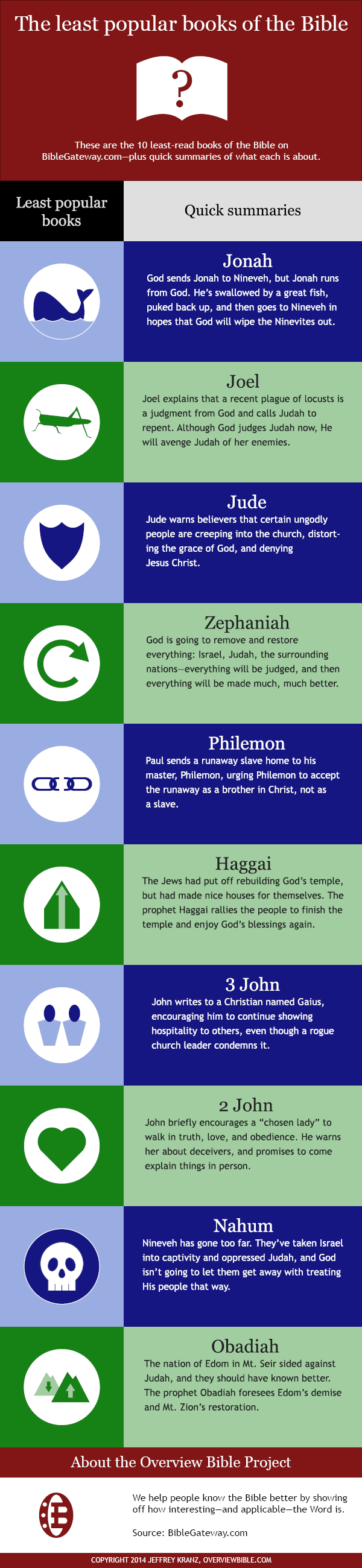
10 Most & 10 Least Popular Books of the Bible
The folks at the Overview Bible Project received raw search data from BibleGateway.com to determine what the majority read and altogether avoid since the inception of the popular Bible tools website in 1993. 20 years of data and Bible searches now in the billions seems like a good sampling.
Surprised to be Left-off the Most Popular List: James. James may be looking down from heaven disappointed* but he can justify this by reminding himself his letter remains a go-to Bible study book with other people, but perhaps we are not necessarily looking for verses of his letter on a search engine or as part of our personal Bible study.
* - unlikely since he is in the presence of Jesus.

Surprised to be Left-off the Least Popular List: Leviticus. Moses surely thought included on this list would be his guidebook that includes how to deal with unseemly cold sores and which precious livestock you need to have sacrificed if you accidentally touch a dead fly. Rejoice my main man, Moses! I've still never heard anyone preach a sermon series from it, but Leviticus ain't no cellar-dwellar either.
Surprised to be Left-off the Most Popular List: James. James may be looking down from heaven disappointed* but he can justify this by reminding himself his letter remains a go-to Bible study book with other people, but perhaps we are not necessarily looking for verses of his letter on a search engine or as part of our personal Bible study.
* - unlikely since he is in the presence of Jesus.
Surprised to be Left-off the Least Popular List: Leviticus. Moses surely thought included on this list would be his guidebook that includes how to deal with unseemly cold sores and which precious livestock you need to have sacrificed if you accidentally touch a dead fly. Rejoice my main man, Moses! I've still never heard anyone preach a sermon series from it, but Leviticus ain't no cellar-dwellar either.
Monday, May 12, 2014
A Wonderful and Free Marriage Tune-Up with Tim & Kathy Keller
My wife Katie and I were blessed both before and during the early years of our marriage with some wonderful marriage mentors. And frankly: We needed all the help we could get!!
Increasingly couples are getting hitched with neither the benefit of mentoring or counseling. You might be one of those people and even if you are not: I am linking below a wonderful marriage overview and refresher in 1 1/4 hours.
Here you can access a brilliant 2005 talk from Pastor Tim & Kathy Keller on Cultivating a Healthy Marriage. You will need to create a user name and PW but otherwise it's free. The couple rotates back and forth speaking candidly, biblically and practically on six major marital hot-spots (again SIX in just an hour and some change!!): (1) Purpose & Roles; (2) Communication; (3) Love Languages; (4) Sex (pre & post childbirth); (5) Conflict; (6) Spiritual Life together.
Some Highlights that were impressed upon me:
Tim Keller, as many of you know (since I've referred to him often and is likely my favorite living preacher) is Senior Pastor of Redeemer Presbyterian Church in NYC. He and Kathy also joined together on a larger work released in 2011 called The Meaning of Marriage - which is not free.
 |
| Tim & Kathy Keller |
Here you can access a brilliant 2005 talk from Pastor Tim & Kathy Keller on Cultivating a Healthy Marriage. You will need to create a user name and PW but otherwise it's free. The couple rotates back and forth speaking candidly, biblically and practically on six major marital hot-spots (again SIX in just an hour and some change!!): (1) Purpose & Roles; (2) Communication; (3) Love Languages; (4) Sex (pre & post childbirth); (5) Conflict; (6) Spiritual Life together.
Some Highlights that were impressed upon me:
- Purpose: (Tim) The purpose of marriage is Gospel Re-enactment
- Roles: (Kathy) The Hebrew idea for "Helper" comes from a position of strength not weakness or inferiority.
- Roles: (Kathy) Great stuff on understanding the roles & value of each person in marriage in relation to relationship of the Godhead in the Trinity.
- Roles: (Kathy) Great point about how both man and woman get to 'play the role' of Jesus in the marriage.
- Communication: (Tim) Never tire of asking: What is the motive of this message I'm about to send?
- Communication: (Tim) Addressing the problem not the person - 4-part strategy.
- Communication: (Tim) Make sure it's a safe place for the spouse to offer criticism by slowing down our responses and giving your spouse permission to keep on talking.
- Conflict: (Kathy) Sometimes you need gospel humility to call a 'foul' on yourself in the midst of the conflict (humbly ask: Please strike that last comment from the record).
- Conflict: (Kathy) Sometimes you need to be the coach by telling your husband, especially, "I'm just looking for a hug here" or " I'm just hoping you'll admit you're in need of help also."
- Conflict: (Tim) Always take time the next day, after repentance & restoration, to to review how you can improve next time - both the trigger of conflict and how you both handled the conflict as a team.
Tim Keller, as many of you know (since I've referred to him often and is likely my favorite living preacher) is Senior Pastor of Redeemer Presbyterian Church in NYC. He and Kathy also joined together on a larger work released in 2011 called The Meaning of Marriage - which is not free.
Friday, May 2, 2014
(FREE Audiobook) If God's already planned it, what's the point of praying, preparing & sharing my faith?
 There is an argument against evangelism goes like this:
"If God knows all things, is in charge of all things, and has planned all things, my friend, neighbor or co-worker will trust Jesus no matter how much or how little I pray, prepare, or share with them."In what is probably the New Testament's paramount passage on evangelism, the bottom-line, takeaway action verb is "persuade others" (II Corinthians 5:11). It is interesting, however: The Apostle Paul makes clear that neither the persuading nor the converting ought motivate us. Indeed, you can imagine how our persuasive performance (or lack thereof) might lead to disappointment about ourselves, bitterness toward God, and even frustration toward the slow of heart we are trying to persuade. Accordingly, Paul gives two motivations to open our mouths about Jesus: (1) The fear of God (II Corinthians 5:11); (2) The love of Christ (II Corinthians 5:14).
He will ask us to one day give an account of how we have stewarded the good news and the tongue that GOD the Holy Spirit has entrusted to us (fear - see II Cor. 5:10) and Jesus has given his life for us (love).
With such teaching, J.I. Packer reminds us in Evangelism and the Sovereignty of God that it's not up to us and, yet, there are enormous and compelling reasons for us to share. Indeed, adopting a vision of a God who is both Large and in Charge can significantly aid us in the cause of evangelism. J.I. Packer is arguably the greatest theologian of the late 20th century. While I don't agree with a couple of his finer points in explaining the doctrine of God's sovereignty, I wholeheartedly recommend downloading and listening to this Free audiobook for the month of May.
Subscribe to:
Posts (Atom)